Search This Blog

WRITINGS & Translations

Books: -  (2018) The Resurrection of Thinking: Steiner's Anthroposophy & the Postmodernism of Badiou, Deleuze, Derrida & L...

Sunday, February 9, 2020

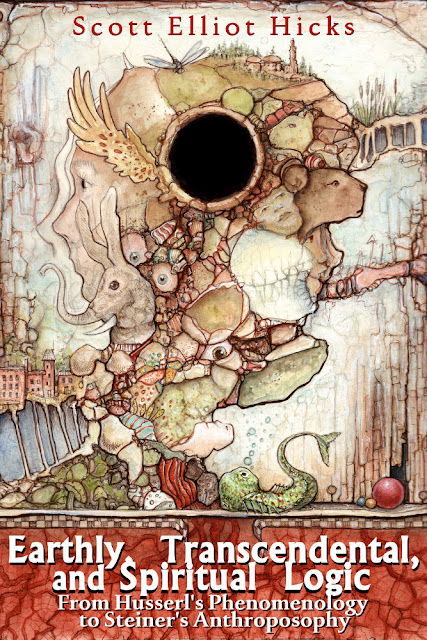
Excerpt from Earthly, Transcendental, & Spiritual Logic (Hicks, 2019) - Chapter 4 – Is the World Imagining Me? The Riddle of Imaginative Variation


Husserl is able to reach toward his refined sense of an idealism, which is grounded securely enough in self-evidence to provide a legitimate foundation for any possible science, by means of a specific methodology that reveals the archetypal or essential forms of the ideal objects pertinent to these sciences. This method takes place in the sphere of the phenomenological reduction, in the realm of imagination, and begins by turning the categorial intuition toward noematic-pictorial instances of relevant types of objects. For example, one could imagine a large number of different mammals, in clear and focused mental pictures, and in a playful but concentrated manner begin to alter the properties of these images in any way one chooses. We might transform the clearly lit-up image of a rabbit into an elephant by expanding the shape, size, coloring, and every other quality of the rabbit until the elephant is in intuitive view as a steadfast image. We then continue moving through a wide variety of other examples until a particular type of categorial object or conceptual framework comes into view in a higher sphere, which consists of the boundary conditions, essential determinations, and the fundamental productive notion at the bottom of every possible mammal. Because we are operating without the presuppositions of positivistic natural science, and are no longer concerned with cases of external fact as actually existent, we are permitted to stretch the fantasy as far as it takes us, while researching all of the possible species that could exist. We could imagine the Discomedusae that Haeckel illustrates from infinite angles, sizes, and profiles. We might therefore imagine some chimerical creature that does not exist, possessing the features of a sea-creature, mouse, lion, and mammoth combined. This fluidity of thought, which takes serious effort and many years to properly cultivate, then reveals the eidos. The particular images are set aside, and another self-evolving fabric of flexibility appears, which is connected to the region of thinking, and thoroughly penetrated with meaning. Husserl’s descriptions of this inner region of concept forms, which are fluid but perfectly clear, vivid, and completely near and saturated, always refer to their uniqueness. He is standing in them with the immediate understanding of their morphology, connections, significations, and boundaries, but they are like nothing seen in the sense world.  He says that the images used as a basis for imaginative or eidetic variation: 

"…present their essence to us; the individual intuition turns itself around, which itself is an eidetic possibility, into eidetic intuition, or into the attitude of thinking which on the ground of intuition grasps eidetic states of affairs in pure concepts and expresses them."

       In an analogous way to the manner in which the noematic nucleus provides a synthetic identity to the concrete instances of meaning-intentions concerning a single theme or object, the eidos is an essential ideal form that governs any possible manifestation of particular instances. One could say that rule that governs the elements of a set contains describable features that are not found in any of the elements of the set.  The wholeness of the mother is found virtually in every actual part. Furthermore, the mother can be seen with the objective Imagination faculty, or with scientific extrasensory perception. The creative power of the ‘empty category’ is the producer of its offspring, it is not the mere container in which they are gathered afterwards. In the same way, the prototypical plant-idea in Goethe shows directly, as it is intuited, that it can produce any plant from itself infinitely. For Husserl, the eidos or essence (Wesen) then can provide a universal basis for an ontological stratification that permits the determinate objects researched by the various scientific disciplines to be hierarchically arranged by category and region. For example, we discover that the intuition (whether sensible or categorial) of individual animals always contains an essential feature that clearly separates these intuitions from those of plants. This imaginative process should not be confused with the outcome of a hallucinatory fantasy. Husserl is convinced that free variation, used as a rigorous scientific methodology, can reveal the necessary foundations of any discipline. The eidetic essences reveal themselves as identical through different times and demonstrate themselves as impossible of being otherwise.

       At the ground of every material science must then be the self-giving of the possible boundary forms of objective research, what Husserl calls an ‘a priori science.’ The eide are the necessary and archetypal forms of possible objects that are referred to in specific judgments and propositions, but these eidetic objects “possess after all a pure essence fixable prior to all judicative content.” One can understand, then that in terms of intentional objects discovered in phenomenology, these eidetic essences are the highest stage and final goal of meaning fulfillment in Husserl’s transcendental project. Of course, a precise scientific language will be necessary to communicate the eidetic features, but language can no more fully express the eidos, than a whole book could completely describe the minute details of the flowers, grasses, birds, and colors in a single overgrown field.  Linguistic formulations and structures are necessarily grounded in the pre-linguistic noemata and eide that populate the sphere of meaning, and Husserl suggests that there is a natural connection between the linguistic expression and the essences themselves.  We find the deeper cause of this if we step into the realm of spiritual science, where we discover that there is an inner word that flows through all unfolding life at all moments. 

       However, it must be made absolutely plain that the eidetic essences are not abstract linguistic definitions that are discovered through a critical reflection (in the sense of the Kantian transcendental deduction) about what features would be essential and inessential to a particular concept. The noema is not a metaphor for Husserl. But the cave of Plato was also not a metaphor. True, Husserl does not yet see the sun outside the cave, but he begins to get close to the exit of the cave. Discovering the eidos is not a reverse deductive process taking place while one maintains the natural attitude of the positivistic sciences, and concentrates on the perceptible features of the external world, rather it is a direct experience of a lit-up object, an individual entity, in a noematic field that is arranged much like a visual field.  The ray of categorial intuition is unified with an individual object in its terrain that presents itself from the ‘front’ or horizon, and although it is not an individual image, it is the malleable source for possible images. Cognizing the essences is “the acquisition of a new region of being never before delineated in its own peculiarity – a region which, like any other genuine region, is a region of individual being.” It is experienced in a full saturation of categorial intuition, analogous in its degree of saturation to watching a movie with the external senses. To be even more precise, it is essential to differentiate at this point between three regions and manners of presentation in the mind’s eye, where a mental image can come to consciousness with the eyes closed.

       A) First, after closing the eyes, one can orient a primary ray of attention to a lower region of darkness in the field of the mind’s eye, while a weaker second ray of attention is simultaneously oriented toward a ‘higher’ region. This higher region is expressing the concepts that one is thinking by means of unclear images. These vague images, which often have a character determined by the impressions of memory, are experienced as unfolding outside the field of inner vision, in a sense, ‘behind’ or ‘beyond’ the primary ray of intention. It is almost as if one were buried in dirt and looking into the dark surroundings with one’s primary attention, while a barely functional periscope was turning around and surveying the air and light above the dirt. Another analogy might help. The experience of seeing someone’s hand in front of one’s face with external perception differs from the experience of feeling this same hand scratching one’s back, in that the full perceptual features are lacking in the second experience. But both experiences relate to a perception of the hand. In the same way, when the primary ray of attention is oriented toward the lower region of darkness (or toward word strings) it is as if the weaker secondary ray of attention is ‘seeing’ the images with the same degree of obscurity that one perceives a hand scratching one’s back. This is the sort of intuition of a representation or ‘mental image’ with which most people are familiar. It is for this reason that there has even been academic dispute about the image character of mental-pictures. Of course, most ‘thinking’ takes place while the eyes are open, and so the primary ray is usually oriented toward sense phenomena. This remains subjective. 

       B)  Through inner effort and practice in precise visualization, one may shift the primary ray of attention toward the higher region described above. With concentration, a new sort of presentation of mental images becomes apparent in this region, which brings them into full relief as clearly ‘seen’ pictures. During the process of ‘thinking’ or during the explicit process of eidetic variation, one can then hold the images in view; it is the case that they now possess a subtle quality that can be compared to watching the images on a movie screen reflected in a stream of slowly moving water. In this second case, the categorial intuition of the mental images is more like perceiving the hand out in front of one’s face, or shifting the primary attention to a fully functional periscope above the ground. Some people experience hypnogogic images which unfold precisely in this region and manner. This remains subjective. 

     C) To reach Husserl’s logical vision it is necessary to go one step further. In the phenomenological shift, which orients itself in order to register or grasp the eidos itself, a second ray of attention must move toward an examination of what is trying to assert itself through (or beyond) the images that are being transformed by the primary ray. The eidos stands forth as a proto-structural principle especially clearly when the primary ray of attention (in situation B) begins to retreat into the background by dropping the persistent tendency of the mind to insert images from remembered experience into this mold or prototype. This is a form of eidetic reduction, in which the presuppositions about what should appear as the essence are dropped, and the inherent biases present in the self are partially set aside. By setting some of the presuppositions out of play, the essence is allowed to self-present its own ideal formal and dynamic element without residue or remainder.8 This reduction then allows the phenomenological researcher to stand in “a world of absolutely pure possibility.”9  This virtual field has an immediate light character and an immediate meaning element within every little eddy or stream of it. The particulate flowing mental image shifts on its own, as it arises out of the imageless concept of immediately understood meaning ‘behind’ it. 

       In my experience, this world of pure possibility shows different qualities than the normal field in which noematic images are perceived (in the clearly evident ‘higher region’ in situation B). This step-C experience is made of an illuminated, malleable substance, and displays a coordinate of ‘grids’ stretching in many different dimensions, that can analogously be compared to the illustrations of curving space in Lobachevskian geometry. 
       
       This ‘game board’ is filled with repetitive streams of colors, and tiny elements that can take on a variety of forms, perhaps like some of Kandinsky’s paintings. This malleable substance seems to naturally take on shapes and impressions, as if it were the film receiving the impressions of light in an analog camera. It is obvious that such a vision inspired Harris’ illustration of the essential components of the second degree of Freemasonry that ends this chapter. It might be worthwhile to ponder this connection further. This is not yet the soul experience of the astral watery-light that Steiner calls the strata of mobile or flowing sensitivity (fließende Reizbarkeit), but it is instead made up of the dying grid of the reproduction of form in the etheric formative forces entering and surrounding the head.11  To move beyond this and cross into the soul and spiritual worlds, one must deal with the moral exposure of the impersonal fields which threaten to snuff out all sense of individuality, sense, and wakefulness. One has to behold the monsters that live in oneself, to truly perform the ‘spiritual reduction’ (could we call it level D? Yet the linear progression must end at level C). Of course, in Husserl’s sense, it would also be possible to perform an intuition of the eidos with the physical eyes remaining open, but the entire process becomes tainted by the overpowering influx of percepts from the external world.  Regardless, this is a problem that has to be solved individually by each serious spiritual scientific researcher. 

       Steiner also often suggested using a type of imaginative variation to grasp the universal or general concept as a mobile creative element:

"But we can also take the triangle as a starting-point, and allow each side to move in various directions and at different speeds…in this way we really do lay hold of the triangle in its general form; we fail to get there only if we are content with one triangle. The general thought, ‘triangle’ is there if we keep the thought in continual movement, if we make it versatile."

       He indicates that through this transformation of the static forms of species into the underlying generative movement, one is able to penetrate into the living spiritual process that creates the individual forms. The pulsing flux, which is the mother of all triangles, can be seen in the same place where one sees concepts.  Goethe, by using such a method, was able to discover the prototypes of plants and animals, which Husserl would call their eide. Husserl does seem to have been able to penetrate fully to level C, but he was focused more on the meaning elements, logical connections and formal ramifications, rather than the organic living power or image character of what was revealed. Steiner calls this noematic element or proto-structural flowing entity, “the living element which ramifies through the whole evolution of the animal kingdom, or the plant-kingdom, and creates the forms.”13  Yet, eventually there is some level at which the spirit of the triangle is just as living as the spirit of the flower. Thus, humans move in a living organic math as the plants grow in the life that underlies the Fibonacci stream. To cross into the spiritual world proper, one has to become the triangle (and yet remain oneself).  Then one can see the dying grid from the outside. 

       Husserl and Steiner will both agree that the concept of the triangle that you think of, is at bottom, the exactly identical one in the concept world that I think of. There is only one Washington Monument, likewise there is only one concept of leaf, zebra, circle, beauty, war, and so on. The psychologism that Steiner found in Logical Investigations became less prominent in the later Husserl. For Husserl, the eidos was the essential interior of the Washington monument. To think together is to plunge into the same ocean.  Humans are able to comprehend that they are accessing the same essence in two different experiences. When we intuit the eidos of ‘mammal,’ or form the proposition ‘The katydids are singing’ at two different times, a scrupulous awareness toward the original sense convinces us, with adequate evidence, of their identity. This numerical identity guarantees univocity of meaning, and thus the possibility of coherent communication altogether.  Of course, the essence is not the representation and it is not grasped in subjective thought.  As the post-structuralists aptly demonstrate, this essential unity does not mean that the meaning-life of the eidos cannot grow and change. It is virtually alive after all, and contains formlessness at the bottom of its spiritual roots. It is a pulsing formless self-differentiation that undergirds identity. Only I outside myself can know it and become it. But this différance is a positive phenomenon, since it allows you and I to create individual meaning elements and imaginative forms out of the identical-difference living in the underlying spiritual formlessness. Thinking is the feature that the formless Spirit creates in man, as Steiner points out.

       From Steiner we discover that there are other beings, forces, and active elements that can be spiritually seen that exist beyond what Goethe or Husserl were able to intuit. The etheric, astral, and spiritual worlds are full of elements and beings that become slowly apparent to the spiritual researcher. Furthermore, as we cross from the elements of color and form, and begin to see ourselves objectively from the outside with all of our moral failings and instinctual motivations, we must first begin to read the colors and forms of the spiritual world, but then begin to set them aside altogether. We are also split into an apocalyptic zodiacal multiplicity. Steiner says the following in his esoteric lessons, which must be received in a gentle and open way, in order to truly begin to understand and experience of what he speaks: 

"The spiritual world is first of all, completely colorless, lightless, soundless and so on. All the colours we see, for example, are not spiritual, but come from our own inner being, and they indicate those qualities which we do not yet have, which we still have to attain. If, for example, we see a red color, it means that we do not yet have love in us, that we have to develop it in ourselves. If we see purple, it means that we must acquire devotional piety. When we hear tones like earthly sounds, it is not something spiritual, but something that comes from ourselves. If someone has an appetite for a certain food, for example, or if someone starts to eat vegetarian food, but still has the inner, bodily inner desire for meat, even if he does not become aware of it, this appetite sounds out in tones, in discordant tones. All these tones and sounds are only the occult crowing of ravens! If a figure from earlier times appears to the disciple and he wants to interpret it in the same way, it is completely wrong. He must be able to wait with the interpretation. The pupil should not interpret in the present, but only later. If such an image comes before our soul, it is destroyed as soon as we come up with our thoughts. But if it is a real picture, it will appear again later and then rest in its true form, and we will know what it means. But we must be able to wait, wait and be silent. Just as we ourselves should not approach the experiences with our own thoughts, we should talk about them much less. We should consider and treat our whole spiritual life as something sacred. With all these experiences of sounds and colors and so on we must tell ourselves that they do not come from the spiritual, but from our own inner being, from our own self, which receives waves from the sea of desires and passions, as Noah's Ark was propelled by waves over the sea. And we must live in the conviction that all these experiences and appearances are not spiritual. By saying this very clearly and relentlessly to ourselves, we must, as it were, surrender our ego, give up the desire of our ego to experience content, to let it fly away, as the dove was let away from Noah's Ark and did not return. But then another occult experience of the disciple comes later. When we have realized that there is nothing, nothing spiritual about those experiences of sounds and colors, when we have realized with inner strength that the spiritual world is completely empty for us, then we realize that those experiences have a meaning after all, a meaning for ourselves. The colors come to warn and advise us then; they tell us what we do not yet have, what we still have to achieve. From the tones we recognize that they reflect bodily desires. And when the images that we have calmly let work tell us their meaning, then the soul is enriched by such experiences. This is like the second dove that was sent forth from the Ark and returned with the olive branch, the symbol of peace."
               

Wednesday, January 1, 2020

From a Blade of Grass to the Upright I-AM


Consider a single blade of living grass. Neither the elemental beings inside the grass nor the human staring at the grass from normal consciousness can really create or see the whole.  The whole is created in the middle, when the spiritual fire of love and knowledge can craft something artistically and scientifically in the middle zone, where we elaborate in language and conceptual fruitful form, a new human notion of grass. We live into the essence of the invisible light of the grass, the grass pulses back into the dying inscription into human consciousness as mental image. This requires us to carefully and self-consciously morph into the life of the plant through spiritual scientific research consciousness, keeping our thinking and our I awake and alert. 

Through this research, the following concepts arise: Grass is the steeple which takes the mineral earth and forms a new substance, striving to meet the heavenly in its neutral leaf formation.  It provides a channel where the liquid falling from the heavens can nourish the earth below, while the blade sprouts and slowly turns in the sweet air.  The blade of grass shows the impossible desire of flight, escaping gravity and with a million of its brothers and sisters, it rises, rises toward the nourishment from cosmic sun, moon, stars and sky. But it weaves its roots through the cool soil. And the human can find some of his or her own nature inside the grass, if he or she can create a concept as a formative open chalice for meeting soul, elemental, and spiritual life in nature.  This is where our work can pass over into anthroposophical fruitful research.  One can then, with the will of the I, look into where this new concept of grass intersects with other concepts – on which side, at which point?  Where does the formative impulse cause the repetitive growth of the blade of grass to connect with the concept of respiration?  How does it connect with the concept and activity of oxygen?  How does the spirit of oxygen, carbon, and grass work with world-respiration?  Here we can find in a single blade of grass the mysteries of the I-forces that live inside the human, as we stand erect, walking on the earth, a self-conscious link between earth and heaven. We are an upside-down walking plant, carrying its warmth around with it.  

Sunday, March 31, 2019

Saint John from Earth to Heaven

I am full of truth, devotion and grace.
I remember when I was once born from the Father.
His glory beheld me. We dwelt with Him.
My flesh is becoming the Spirit-Word.

I believe in His Name. The spirit wakens in Man.
My flesh becomes the spirit's will. My blood becomes the soul's life.
The I is born as the Son of Man in me.
And the Son is born in the I of God in Thou.

My power is in my belief in Him, for He received me.
But He came to me once and I did not at first receive Him.
Yet I sense Him now when the World rejects Him.

His true light set fire to my I, and lit up the world.
My light becomes true through Him. I bear witness to His light and believe.
I am John, a free man, sent to Heaven, to bear witness of the Earth.

The darkness of the earth begins to understand the light.
The earthly obscurity begins to shine in the light.
Man's new light shines into God's life.

Nothing and Everything were made by Him.
The Word of Man was in the beginning and will be in the future.
In the future I will be with God's Word.
And the Word of God will always be with me in Him. Him in me.


(March 4 1019)

Sunday, March 24, 2019

Quartz & Human Transformation

                                           Photo of Quartz by JJ Harrison from Wikipedia


       An extract from my new research on chemistry: 

       The body becomes the stone of transparent quartz
       The etheric body becomes the liquid of clear quartz, flowing with inner light.
       The soul becomes the vapor of quartz
              Spread a translucent warm inner light in gentle sacrifice on all sides
        The Self becomes the spirit-I of quartz
              Becoming clarity and giving birth to true illumination
              In the center of the World and the Human Being.

Saturday, December 8, 2018

Jack Kirby, Levinas, Ben-Aharon, Steiner, Deleuze?

Jack Kirby, Deleuze, Yeshayahu Ben-Aharon, and Levinas?
An Extract from 'The Resurrection of Thinking' (2018) -
"Our hearts are shattered and filled with hate to protect their painful vulnerability. The deepest evil tendencies in me can rise up, but I can find ways to bridge and transform them with hope and creative love. Both the act of repose and the kinetic are rhythmic polarities in a pulsating metamorphic fluid that is sometimes inward or humanlike and sometimes outward or worldlike. Creative thinking must find ways to tie together temporary organelles of every quality into a new human actor. Like Jack Kirby’s Mister Miracle, we can become a super escape artist who doesn’t mind getting back into the coffin once again. The supersensible-I can slip out of any trap, but it can also turn back to face the real bottom floor of moral evil in its own most human earthly nature. But who is this new kind of human that can begin movement and slow down to a rest, this wave of supersensible lightning? Where does rest take me? What kind of self stays awake in the yonder? And these should be ethical questions.
Deleuze says, “Even Bergsonian duration has need of a runner.” We have to build and maintain our own quality of self and conscious organs here and yonder, otherwise other spirits will put us to sleep and we become an effect of their moods and deeds. We have to surf the disconnected Deleuzean planes of immanence, but without ever forgetting the holocausts that burn in the center of our own humanity, as it pulses through our times. Ben-Aharon describes the entire moral gesture upon which we can model our new self as well as the most critical world situation which is still alive today, in 'The Spiritual Event of the 20th Century.' We can only add a small extract here:
'The Higher Self of the whole Michael community, lives also in each of its single members as a special, individual higher self…It is a Christ-like being, united with the destiny of humanity and the Earth as a whole. This being now experiences the Revelation [the first stage of the spiritual Event taking place during 1933-1945] as the deepest division of its own inmost being…Never before has it been possible for fully individualized human beings to experience such a cosmic, earthly and all-human split as a self-experience…The Michael pupils felt the most tragic soul bewilderment and helplessness in face of this split because of the simultaneous occurrence with the highest Revelation of spirit community and oneness. This tremendous inner paradox and self-contradiction was caused by a fissuring of man’s whole new Earthly-Sun being. And out of humanity’s helplessness in the face of the evil surfacing from the abyss, threatening total self-destruction, there emerged a mighty soul and spirit mood.'
Can we with the greatest humility and resilience, keep this mood alive today as we craft a new self and learn to move in spirit-space? This Event is still alive today and new Events are coming from the most innovative future. To remain conscious in the midst of these moral world-riddles, while the rotation of the universe churns in us, requires the most careful, objective, and scientific scrutiny. It is not accompanied by paranoia, delusions, hallucinations, or an overly ecstatic feeling. Indeed the extensive feeling of responsibility can be painful. But thank God that the pain reveals itself to be the intensity of the neutrality of the macrocosm piercing our warm, immoral bubble.
Levinas says, “In proximity the other obsesses me according to the absolute asymmetry of signification, of the one-for-the-other: I substitute myself for him, whereas no one can replace me, and the substitution of the one for the other does not signify the substitution of the other for the one. The relationship with the third party is an incessant correction of the asymmetry of proximity in which the face is looked at…it is only thanks to God that, as a subject incomparable with the other, I am approached as an other by the others, that is, ‘for myself.’"
Read more -
About this website
AMAZON.COM
The first full-length text in any language to wrestle with the conceptual relationship between the spiritual science of Rudolf Steiner and the French Postmodern thinking of Jacques Derrida, Alain Badiou, Gilles Deleuze and Guattari, and Emmanuel Levinas. Furthermore, the book is a living investig...

Saturday, December 1, 2018

Michaelic Essence Exchange of Color - Rainbow Grasshoppers


Dactylotum bicolor, the Rainbow grasshopper, can be a wonderful inspiration for people who are interested in the new Cognitive Yoga or the Living intensification of Perception and Thinking. One could call this new science, breathing in colors and breathing out pure thinking, and then opening a doorway in the middle. We ourselves can learn from this grasshopper, how our reverence to colors can be 'breathed into' our whole body, soul, and spirit (however, we do not alter the physical breathing at all). We bring all that was done unconsciously to this grasshopper into full creative consciousness. We can experience the two antennae in our heads like Ms. Grasshopper, but now creating a third wakeful organ in between. We see that Mr. Grasshopper has two hands at his throat, we ourselves can create a new living-speaking organ in a similar fashion to communicate with the new life that is streaming all around us, in 2018. We don't have to lower our consciousness to become ancient grasshoppers, but instead we keep our I AM fully awake, and 'perceive' the moment by moment activity in our concepts, and the light behind concepts opening us from the outside. What do we experience when we KNOW and dive into the contours of the concept of any grasshopper whatsover in our wide awake thinking? Will we be able to create wings to fly down into life, like dear Mrs. Grasshopper? What will human wings, created little by little out of morality and virtue look like in the future? You will have to decide, since each one of you is your own species.

Sunday, November 25, 2018

Matisse, Marrying the Lady of Space, & Cognitive Yoga


'Entrance to the Kasbah' by Henri Matisse (1912) provides a wonderful invitation to enter into the world of pure color. We find that the dimensions of regular space have collapsed as we gently dive into the painting. What could be recognized as a doorway in everyday consciousness, becomes turned inside out and topsy turvy, when we separate out our mental images, memories, personal ideas, and projections of desire and control from our moment by moment experience of pure color. We become the 3 dimensional doorway, as the red pours into us. We fill the space outside our past body. We engage ourselves, or gently propose to marry the multicolored woman of space. She was once invisible but now her pregnant full body is everywhere, in every nook and cranny. And behind her is another mother, multicolored, rainbow life. She weds me in ever moving, ever metamorphosing color and hue and shade. But my I is now awake, and I turn to the thinking pole, which opens up a new realm of archetypal invisible meaning life, behind and between every color. And what is in between the pulse of thinking and the pulse of color?  Do I sense the flood of time? Do I hear the moral call of the unheard speech of color calling to me?

Saturday, November 24, 2018

Herbart, Badiou and the Spiritualization of Logic


                                                                 sculpture by Tomohiro Inaba


Herbart, Lehrbuch, Pt. II, Die Logik, 77.

“The given concept has n marks. If we leave one away, then a higher concept arises in
whose extent it lies. If we leave one more away, then a still higher concept arises, etc., until
only one mark remains, which allows no further abstraction. However, we can leave out a
mark in n different ways; this gives the number of n higher concepts to which the given
one can be subordinated. The theory of combination proves further how many concepts
will be found on each higher level.”


We can see here that if we can stay awake on the virtual blockchain when we are removing the marks, we can also open soul windows into the land where the spiritual concepts become apparent. We make the move of experiencing the erasing as an extraction to the void outside the concept-activity (directly viewed in supersensible intuition). Then we find, that the heart (now spread out in the world) can perceive the creative human activity of linking, turning, and folding and unfolding concepts on the concept-virtual-plane (the same as the river of flowing proto-light virtual blockchain). To spiritualize this (or allow it to be nourished by the spiritual world), we can then look into the moral validity issues of each move of the concept. This becomes a conscious co-working with the spiritual moods, development and beings that work in the world as living and loving thought-spirit-actors.

Apples and Cognitive Yoga


Behold the red apple:  In it we find the cosmic and earthly combined. In its redness and sweetness, it holds part of the secret of the I, disappearing and reappearing in the living poles of north and south. Now, dissolve the red apple into the deep blue sky. When it disappears, but you remain awake, the golden light of spiritual resurrection may return from all sides, bringing light into the darkness, if God wills it. Now, find the living concept of the Apple, beyond image and take your spiritual feeling out to meet it. There you will hear the silence of the gas flame burning and you will feel its warmth. All tone and images disappear, but the wakefulness of the I-World breathing remains. Through vast doorways, the Spirit-I comes to meet the human-I, and the spirit of the heart awakens as a center, filled with the pain of self-knowledge, but also hope. If you eat the cosmic sweetness in pure heavenly light, you will lose the way. If you only enjoy the earthly apple in complacent sensible taste, you will fall asleep in deception. But, if you can transform the dying apple into life, paralyze and localize the spiritual apple into death, you will find the spiritually transforming human spirit in Christ.

In this process, one must know and become a multiple group of beings: the witch, snow white, the dwarves, the forest, the poisoning-wakening apple, and the prince - all working through the creative harmony of the spirit-I.

Sunday, October 28, 2018

New Book, "The Resurrection of Thinking" Now Available!


New book is now available: "The Resurrection of Thinking: Steiner's Anthroposophy and the Postmodernism of Badiou, Deleuze, Derrida & Levinas" Scott Elliot Hicks (also author of the 2005 novel, "The Shattering Light of Stars.")

The first full-length text in any language to wrestle with the conceptual relationship between the spiritual science of Rudolf Steiner and the French Postmodern thinking of Jacques Derrida, Alain Badiou, Gilles Deleuze and Guattari, and Emmanuel Levinas. Furthermore, the book is a living investigation of new ways of deactualizing and taking the first steps in spiritualizing thinking, perception, sensation, language, and willing. It is a direction demonstration of original spiritual research and creation, inscribed and readable by Intuitive Thinking and Moral Imagination in a vibrant, breathing experiment of the weaving together and opening up of living concepts. It is a sensible and supersensible cognitive-chemical experiment carried out and followed moment by moment one step beyond subjective, transcendental, and phenomenological research. The text operates in a neutral field, which does not try to interpret or critique, but rather opens up the direct perception of the concept plane and its new moral intensive fields, and the activities and events engendered there. This text brings Anthroposophy into direct contact with the most current elements of the evolution of world-thinking, using its life and light to illuminate the fresh notions in the most up-to-date philosophical thinking.

Wednesday, November 16, 2016

Cognitive Yoga by Ben-Aharon a Review


Finally! Here is a book that shows explicit, clear, and non-sectarian methods for spiritual development and research in the most genuine sense. Here is a book for fully conscious and free modern people, living completely in daily life, which has nothing to do with following some Guru in the Himalayas, or subscribing to a new religious dogma. The Cognitive Yoga or spiritualization of thinking and perception that is carefully explained in the text will appeal to researchers of consciousness in every field and mode of pursuit, whether they are Wiccan, following the Golden Dawn tradition, orthodox Jews, atheists, electrical engineers following the path toward free energy, Buddhist, Catholic, Protestant, Muslim, and so on. The ancient eastern yogic practice transformed inhalation and exhalation of the breath into spiritual experience outside the body. This practice is no longer healthy for modern human beings. But the new cognitive and perceptual yoga, where one ‘exhales’ personal thinking into universal world-thought outside the body, and ‘inhales’ pure color and sensation to transform the body, offers a healthy and sane path of the development of consciousness for modern human beings everywhere, no matter what faith you follow. In fact every mental image and ideology that you have before you begin will be challenged and transformed by the cognitive yoga practice itself. In this way, it uncovers the pathway to a self-grounded experience which is no longer one-sided. This book was written for what is most human in every single person on the earth. It shows the individual how to develop, above all else, in a truly moral sense. How? By leading human consciousness to the field and source of all moral impulses.

The text is built on the ground of the strongest capacity of the human personality selfhood and individuality, but shows how to connect your free individual nature with your highest and most essential nature, living outside your old ideas of the physical body and outdated concepts of space and time. It is in line with the most progressive concepts at work in biology, physics, philosophy, and politics. Cognitive Yoga has been written to offer a reasonable and scientific alternative to the soon to be realized dream of the AI researchers: downloading a human life into a machine. This book offers the complete method for uploading our life and consciousness into a freely created spiritual body, which is not in far off Lala land, but which remains connected to the spiritual sphere of the earth, and to a fully aware and active physical life. This is not a path of escape, but a path to begin living responsibly and maturely. This book is for humans who want to be creative in transforming the spiritual form of the earth, and giving substance to its future nature. All of this is based on the 40 years of research, work, and experience of the author, as he has encountered and engaged in open partnership with the new spiritual Event that is happening in the spiritual world in our time. The source of the work is the same living source that inspired the anthroposophical developments of Rudolf Steiner, and Dr. Ben-Aharon has brought real spiritual research into the 21st century. He is not offering unexamined dreams, hopes, wishes, or visions, nor is he merely using abstract words and concepts which are empty at bottom. What you see in this book is carefully researched and reexamined information and substance gained from years of first-hand experience living in the spiritual world as a daily reality. It is not speculation or a mere summary of Steiner in a new form. The ancient yoga practice was offered as a gift to the Western world, now it is time for a fully modern yoga practice to return the gift to the world. It is a spiritual path guided by the true spirit of our time.

A case in point: have you ever seen a book which shows you how to spiritualize your sense of smell?

Have you ever read a book which shows you how to create the organs of spiritual speech from your experiences following the living creative impulses in a painting?

Have you ever read a book which shows you precisely how the highest Spiritual Self can lower itself into you to transform your lowest instincts into spiritual organs?

These things are in this text, and much more, including preparation for the work of the supersensible work of the Michael School in actively transforming evil in the supersensible heart of the Earth.

Are you ready to begin creating a new etheric body and a new spiritual individuality? This book is in a class by itself.

“In daily life, we live in our physical body and use our senses and our intellect. When we are meditating, we live in our etheric body. We must become completely free of the body in meditation. When we are meditating, we live in the heavenly body, in Christ. What do we do then when we meditate? We form something new, we create something new in the cosmos. We imprint a new etheric body upon the cosmos. When we bear this is mind, then we will gradually become aware of the great responsibility for what we do when we become a meditant.” Rudolf Steiner, notes from Esoteric Lessons, Vol. 3 (GA 266c), pp. 289-90.

Thursday, April 21, 2016

The Work of the Global School of Spiritual Science under Yeshayahu (Jesaiah) Ben-Aharon

The Work of the Global School of Spiritual Science directed by Yeshayahu Ben-Aharon

“I will begin by a short description of a spiritual-scientific esoteric method, which has developed since the beginning of the 21st century. More and more people are asking for such a method, because they wish to become relevant to the world’s real social needs. Social engagement is an esoteric art of living, of being active in the real world in a wholly transformed manner.  Many well-meaning activists today, even those with anthroposophical backgrounds, want to change the world but they want to do this by means of improving the soul faculties that they already possess, in order to achieve greater results in influencing the social situation. There is no question, of course, that our ordinary soul qualities must be greatly improved. This will always belong to any true esoteric work.  But this improvement of our ordinary faculties is not done in order that we will be more capable of changing things that we don’t like and implementing things that we happen to like, because what we like and don’t like is not at all important for the real world.  It is about finding the way to know in the first place what is right from the point of view of the real world, not what we believe is right because of our likes and dislikes. But what does this mean in reality?
               When we face any given situation or event, our task is first to transform it into “Event,” with a capital E. What changes a small event into the big Event is this:  that we struggle to find a way to get out of ourselves and our habitual soul patterns of reactions, which include our desires and wishes to “change” the social or political aspect of whatever world situation we confront.  The whole point is precisely to get out of our habitual soul patterns, reactions, and desires, and not to seek for a way to improve them in order to change things according to our wishes. This means, not to grasp the event and use it for whatever we want to use it for, but to reverse this attitude entirely, to turn it inside out.  To be grasped by the real spirit of event is what transforms the small “e” to a bigger “E.” And this is possible only if I merge with a given event, or situation, and let the Event change me, instead of trying to change the event to suite my wishes and beliefs.
               Being transformed by this merging, one becomes its expression; one becomes the Event’s implementation, its self-actualization through one’s self. But the same applies not only for our desires to change the external social world, but also for our inner desires to develop higher spiritual capacities and experiences.  Both have the same problems:  they wish to implement their own wishes, desires, likes and dislikes. How do we know if anthroposophical study and meditation are real events and not just self-reflecting, inflating, subjective illusions and dreams? Only if they take us out of ourselves entirely, if they truly plunge us into the altogether different, non-personal, non-subjective, spiritual reality of the Event.  The difference between this experience and all others is as essential as the difference between, say, the experience of being burnt by real fire and a mental representation of fire.  So the person that experiences the difference will never be prone to confuse it with subjective soul experiences, feelings and mental representations of thinking. Grasping an objective event means being reciprocally being grasped by IT. This is the essential difference between the subjective and objective in spiritual cognition and practice and in social activism and its practice, and this is therefore the beginning of true, social esotericism.  Being grasped by an objective event, I am becoming this Event. I don’t make an inner representation about it, or indulge in my sympathies and antipathies to it. The world situation becomes self-conscious through us, as we let objective events be transformed into intensively experienced, heartfelt questions of conscience. These must be strongly distinguished from the subjective soul reactions that we experience in each event.
               The soul reactions are natural, and sometimes also justified (although often they are not), but the point is not if my reactions are justified or not from this or that point of view, but precisely that they are my natural, habitual, characteristic reactions in the first place.  Events and situations occur in the real world. Your reactions can tell you a lot about yourself, if you are truly interested in acquiring real self-knowledge, which would mean to meet yourself objectively as a world Event as well.  But your reactions will certainly tell you nothing about the essence of the real Event.  If I notice my reactions and wholly put them aside for a short time at least, I can let the Event speak in its own language, in its own right.  And I should feel this ever stronger:  that the Events have the right to speak about themselves in me, not only to hear my soul chatter about them.  In our hearts, we learn to listen to the Event’s language and the Event’s thinking, and what we hear is transformed into existential problems and questions. The hearts begin to have real, world-related, world-imbued, questions and problems.   This means that if we truly experience that the problems have emerged from the world, we will no longer be happy with our own common answers.  Because these new problems do not come from our inner reactions, pleasures and displeasures with the world, so also the answers will not originate there.
               As the term “dialogue” has become overly psychologised, I am reluctant to apply it to the esoteric method of working with real, existential, spiritual events and processes. So let’s say that the transformation occurring between external events and inner questioning allows the spiritual world to fire our hearts and offer its own interpretation of the Event, revealing its own perspective.  We are not less free, but far more free now, to actualize what we perceive, as our sense of freedom has also been transformed in the process.  I say, I want to be free to truly co-create with the will and thinking of the real Events and beings of the real world.  This leads to an objective inspiration or an Inspired Event and the result is a fully individualized and embodied moral-social evaluation and judgment, which directs our will and resolution toward the truth of the matter at hand, awakening and firing our will, pointing to what needs to be done.
               Can we let the objective spiritual content take us into itself instead of taking it into ourselves to use it for our personal aims and gains? And what is experienced when we let this happen?  We would experience how we are assimilated so deeply into the objective contents of the event, be it a person we meet or any other event or process in the real world, until we are ready to become what it really is, which in any case, is not our own self. What a wonderfully refreshing experience to become a wholly different and unknown self, to forget all about our ordinary self, through the other.  Then to experience, not the results of the privatization and appropriation of the other person to our own inner subjective reactions, needs, desires and interests, but the very opposite, the very reverse of this. How the other person, as an unknown, unexpected, often truly unsettling and perhaps “not nice” or pleasant being, is becoming so infinitely interesting and worthy of my love. And this means that the true esoteric life of the Event begins when I experience this “not I but the other in me” as a reality.
               In this way, as Rudolf Steiner recommended, real spiritual events can flow as spontaneous impulses that can unite themselves with us because we feel that this is what we truly want to become, and that these are our own immanent spiritual ideals. Michael is a spirit of action, initiative, courage and universal human cooperation, who is beyond sectarian differences of language, culture, gender, religion and ideology.  Esoteric life and practice of the Event, means, therefore:  reversing our common and unconscious appropriation of each event, transforming each event into a real Event, working with the world’s inspiring forces, with the other’s inspiration of real forces. We work in and out of the given situation, changing and shaping social reality and changing ourselves as part of the world in which we work and strive.” (From Spiritual Science in the 21st Century, Yeshayahu Ben-Aharon, 2013, pp. 38-40)

                             
                     Do you want to learn more about this work?  Do you want to join us in this work?  If so, contact Scott at zoltelitichts [at ] protonmail.com


 “The goal of the school is to use written texts and life's experiences not for knowledge's sake but as fertile compost in order to practice, real, active, soul and spiritual training of new faculties in and through the meeting with others. Spiritual knowledge is not transmitted to encourage the pupils to gain more knowledge that can be privatized and appropriated, carried in memory as dead, conceptual scheme and entrenched in sectarian and dogmatic personal and social habits. The school is founded on the conviction that only real meeting with the self through the other, and vice versa, can develop the faculties needed to create healthy and productive personal and social life in our time.” (Dr. Ben-Aharon) 

Tuesday, June 18, 2013

2nd Review of Ben-Aharon's 'The Event in Science, History, Philosophy & Art' (2011)

             In the new book, “The Event in Science, History, Philosophy and Art” (2011) the philosopher, independent researcher, and social activist, Yeshayahu (aka Jesaiah) Ben-Aharon has provided a carefully built introduction to what he calls the process of singularization.  He borrows, twists, and reconfigures a wide variety of concepts from a dizzying array of thinkers over the last 50 years, in order to provide an alternative to Ray Kurzweil’s project of preserving human consciousness through computers.  Kurzweil thinks that merging human and machine, that is, virtualizing human consciousness, is a positive step forward for humanity, while Ben-Aharon argues that a totally different kind of virtualization is possible.  It is not that Ben-Aharon has any irrational fear of computers, but he has found a distinctly human way, a healthy way, to use new ideas from the 20th and 21stcenturies in order to transform the face of the human and the world altogether.  He argues that by artistically and scientifically transforming our thinking about the human being and the world, we can grow beyond the traditional and incorrect notions of subject vs. object, inner vs. outer, life vs. matter, thinking substance vs. extended substance and others.  Through this we find and create a new world and a new human constitution. As a foundation to reorient the reader’s ideas, he starts off the book with cutting edge concepts from physics and biology, especially the notions of open systems from Prigogine and extended mind from Bateson and others, along with new notions of the mutual interaction between genome and environment as outlined by West-Eberhard.
               But Ben-Aharon does not simply imagine that by merely changing our ideas can we change the world and create a new stream of human becoming or a post-organic human.  (Who would want to become some kind of human floating out nebulously in space, without a real center or a real ground anyway?  Isn’t this a crazy, totally, impractical postmodern idea?  In the book, Ben-Aharon addresses these questions in a decidedly human way).  Instead, his research over 30 years has convinced him that there is a new Event happening since the middle of the 20th century, which is already changing the nature of the human being and the world.  In his earliest books, he investigated this Event in terms of Judeo-Christian and Anthroposophical terminology, but here he avoids and transforms that language altogether, using instead the language of postmodern philosophy.  There is a new creative impulse which has produced real opportunities for growth but also a deep split in the inner nature of the human being.  By pointing to this destabilizing impulse in the concepts of science, history, philosophy and art, he gives a convincing and subtle interpretation of contemporary psycho-social problems on one hand, while giving an explanation of the source of new ideas in a wide variety of fields.  There is, what he calls, a ‘loosening’ of the life and formative forces from their organic foundations in the physical body.  This causes a real psychological division in the human being, which has led to many of the tragic events, existential crises, and nihilistic viewpoints of the past 100 plus years.

Some people may have trouble accepting the complex terminology of Deleuze, Levinas, and Badiou, for example and may wonder what Ben-Aharon’s notion of virtual really means.   Everyone can picture the purely electrico-mechanical virtual reality produced through our computers and video games, but is it so clear what Ben-Aharon means by virtual?  He seems to be staying close to Deleuze’s definition as something that is like an idea, but not strictly visible in the world.  It has a potency and an infinite potential, and a certain kind of reality.  You can experience it, in the same way you can experience someone else’s concept or memory, but it is not actual.  Although he rarely uses the word, Ben-Aharon seems to be equating it with a ‘spiritual’ dimension inside the activity of thinking, but it is not a Platonic Idea, and not a return to Platonism or theological ideas or even an Intelligent Designer.  Ben-Aharon vehemently argues against any such approach.  He argues that biology and research into AI, perception and cognition has already shown us that thinking, meaning, and consciousness happen in the actions of the outer world, and not just inside the skin of the human being.  Humans can meaningfully become in the streams of the evolving life in the whole environment.  Humans can think inside the activity of the world, inside the motions of his society, and in real healthy meeting with other people each day.  The human is not just something happening inside the surface of our skin, and the world is not just something happening inside a dead, meaningless motion of energy.  These are incorrect concepts, as many fields of research are already showing.  Ben-Aharon uses these productive ideas to move his own project forward.  The human mind can think and be conscious inside a pure realm of conceptual development, which is just as real as what is encountered in perception.  But there is no little man sitting inside the brain absorbing and controlling it all.  The same human consciousness can think, feel, and act inside the changing nature of the artistic work, whether it be a canvass, a musical instrument, pure vibrations of sound or linguistic forms.

          I offer 4 excerpts from this brilliant book below:                               
CHAPTER 1 – Science:  
Placed in the whole context of our study thus far, we can say:  human becoming, understood as evolution becoming conscious of itself, brings to expression nature's general strategy of evolution as a whole.   This "strategy" is indeed remarkable, because it makes evolution possible by means of ever recurring phases of involution.   Meaning that the more evolved beings are those that have managed to integrate and embody in their bodily plans, organs, and functions, more of the universalizing, neotenizing, characteristics.
            “We evolve "higher" and further by “going back” to our primitive, less specialized, more open, beginnings, and take our next jump ahead not from the pinnacles of our most complex and sophisticated tips, but from our most embryonic sources.  This is because those sources are far richer in potentials, and open for adaptive variations and selections, than the already formed specializations of an advanced evolution.   This is the reason why we discover that neoteny and related phenomena (juvenilization, paedomorphosis, fetalization) are not chiefly  primate or human phenomena, but universal; they show themselves so clearly in human becoming only because they are everywhere present in nature, and as many new researches are finding out, they are indeed far more central to evolution than was previously thought.”


Chapter 2. History -  “The most essential observation here is that what is individualized is precisely the universal.  The human individuality feels and experiences herself as a universal human being, precisely by dint of experiencing herself as a private personality.  We come to realize that it lies in the nature of the case of modernity itself  that the universal is individualized in so many people on one hand, and that the individual is perceived as individual only because she is rooted in universals, on the other.  But privatization of the universal and generalization of the individual means a mutual reversalfor both.  Universal force and power is put in the service of a personal, private ego, and the same personal ego feels itself enlarged by this into universal dimensions.  Transforming universal into individual means nothing less than individuation (or privatization) of the universal, which transforms and reverses the universal and makes it into a personal private possession.  At the same time, the universalization of the individual allows the personal self, the ego, to expand its private egotism and make it universal egotism.  Egotistic universality, on one hand, and universal egotism, on the other, merge together in this double reversal.  In other words, modernity means exactly this:  placing the content and force of the universal (God, Nature, or Idea) into the hands of the individual, private human personality, gives it increasingly powerful means to control, change, and realize this force in its economic, political, and cultural life and to use it in its research, utilization, and manipulation of nature.” 

 Chapter 3, Philosophy:  “The new representation will be different, because it carries in it a re-mark of a real difference between the virtual and actual and therefore will provide an improved envelope of cognitive or social embodiment, with new elements and possibilities.  For example, it will be, pictorially speaking, more pliable, flexible, and more open for variations and transformations.  This means the cognitive or social forms created in this way, will also be much more easily discarded when their function is over, because the virtual that they actualize and never forget, will remind us of the vastly richer variations and differentiations also available to express this event, when changing circumstances demand it.
“The whole process of re-actualization is done consciously, without losing sight and forgetting the potential of the reserved event.  We attach and tab the potential of the reserved event to the re-actualization process, but keep it strictly separated from it, maintaining its existence on a higher floor or field of consistency.  We let it hover above and accompany the whole re-actualization process as a cloud of the unborn, without letting it deplete its reserved virtual force in physical realization.  The consummated re-actualization process and the reserved virtual force are like two identical twins that have been divided at their virtual conception like Castor and Pollux and separated in the moment of conceptual or social realization.  But as all twins do they retain a secret connection through a quantum-like non-locality and remote affiliation that continues to resonate and vibrate, also from afar, disjunctively, after the earthly birth and cosmic death of Castor. 

“We operate here with a capacity that allows us to "remember" non-locally and non-timely the event and its virtual origin in our virtualized memory during the whole series of these stages of re-actualization and realization, in the same manner - only consciously - that is done by all natural organisms.” 

Chapter 4, Art – “The reason for this is that particularly in our age, in order to become a properly tuned and conductive instrument of cosmic forces of becoming, the artist’s sensitive constitution registers the physical’s body illness and death processes much more strongly than any other “normal” person.  The artist cannot but feel intensely the physical body’s death and virtualization process and the labor pains of an emerging embryonic invisible baby body.  She is mothering a newly conceived creative offspring, fructified by the cosmos, and therefore she becomes aware to what extent the organic body almost dies when it is preparing itself to receive and conceive a cosmic influx of becoming.  It becomes dismembered inwardly, and precisely in this way begins to transfer virtualized forces. Its dismembering creates a super-conductive substance that transfers inorganic fluidity, intensity and flexibility.  A common threshold experience, the feeling that the ground falls away under one’s feet, for example, is a result of this.  For each of us, naturally, as we grow older, the body disturbingly falls apart all the time, the connectivity of tissues, the adhesion of muscles and the cohesion of the blood are hollowed out, dismembered inwardly, and so forth.  But the artist experiences also, not always in clearest consciousness, how his solid and robust physical body begins to become a hive-like buzzing multiplicity, or better, a swarm-like assembly of independent and miniaturized cellular, molecular and microscopic particles and germs.  The artist experiences how her own body doesn’t belong to her anymore, how it seems to be contagioning, cohabitating and conspiring with others, becoming others’ lives, invading any last possibility of privacy and autonomous inwardness.  But in reality what is happening is that the body is being truly in-spired, hankering to liberate its bound organic life and spread it over and above its bodily organic limits, and is therefore often felt to be constantly threatening to expose and explode its organic form and also the subjective soul sensibilities and functions.
 “However, when understood from the other side of the threshold and not through psychoanalysis, this process is precisely the body’s healthiest way of rejuvenation, of re-linking with terrestrial and cosmic forces of elemental life, through which the falling apart of organic connections between cells, tissues, organs and limbs, is compensated by vigorous non-organic bodily formation processes and vitality.”


Saturday, February 2, 2013

A Review of Yeshayahu Ben-Aharon's 'The Event in Science, History, Philosophy & Art.'

Glancing at this book, someone might suppose that it offers a survey of new ideas that have arisen in these four broad fields over the course of the last forty years or so. This is true, but only if we look at the text quite superficially. Since Ben-Aharon discusses such a large number of scientists, philosophers, and artists, from Prigogine to Derrida to Andrew Wyeth, some might imagine that this book is only secondary literature, which is either trying to offer interpretations of the content and value of the ideas of the second scientific revolution, deconstruction, and post-modern art work, or trying to adopt or critique their ideas to suit some political, religious, or social aim. Not really. 

The inner core of the book is deeply penetrating, radically insightful, original research by Dr. Ben-Aharon himself. He has actually used the concepts, problems, and paradoxes of modern thought to build something. He has built a living formation in a dimension of real life that can be used to become a new type of human being altogether. He has built a tool, and has showed us how to begin building our own tools. Someone who has read his earlier books, might suspect that he has abandoned his earlier worldview altogether, since he no longer uses anthroposophical terminology. This would also be an error. The book stands in a class by itself, as does the author. He stands and moves and fights in between many different worldviews, many different concepts, and many different forces, without merely taking up with any one of them in a one-sided manner. He has become a singular middle man, who penetrates fully into a tremendous variety of ideas, but does not take them personally. He has tried to build an open living concept that is clearly able to be cognized in everyday consciousness, an organ that is no longer merely personal or egoistic, that has the capacity to be open to the new and real Event of our times – an un-thought Event that makes everything new. 

What is this book? This book is a call to the reader to act! But this action is a new science, the ability to create your own concepts in full consciousness, so that these real ideas can become a body without organs in which to become a new kind of human: a person that is not a subjective personality, nor some grandiose imaginary demi-god or revolutionary that wants to conquer or “save” the whole world with one simple idea. The concepts in this book should be worked on in meetings with real other people, our neighbors and colleagues – since one of its primary purposes is to show that the time of the hermetically sealed personality is done for. This book shows how the new scientific concepts themselves are overturning older simplistic views about nature, genetics, and matter – but this book is not Idealism. Ben-Aharon critiques both Communism and Capitalism as being reversals of their true, unrecognized source, never itself visible in history. 


He shows that our modern world is built on the very fact that we personalize, condense, and turn reality on its head in order to live our ‘life’ as free individuals. He then shows us how to de-personalize, expand, and propel our thinking to a middle spot that is able to watch this ever present cognitive process of destruction. A process of free becoming, encountering the real shock of the Other, allows ‘us’ to create anew out of this destruction. This book concentrates on drawing the reader’s attention to the reality of the field of life, sensations, meanings and concepts in themselves, but it is not phenomenology or mysticism. Furthermore, Ben-Aharon follows Deleuze in the creating of a virtual science, but in contrast to the French post-structuralists insists that the human can meet and create a real, consistent, self. Yet, this self cannot be captured by any of our mental pictures. The whole course of the book functions as an education and an impetus to develop free new concepts of the world and ourselves that can be used as gear to transform our consciousness in totally healthy ways.  


This is, hands down, the most important book to be written in the 21st century. Why? Because Ben-Aharon understands exactly where we are at this moment, and just what needs to be accomplished by human consciousness in order to take full advantage of the new possibilities of human culture which are just emerging now. The centerpiece of this text is a demonstration of how we can extract a virtual and living essence out of events in our biographies, artistic experience, and thinking, and develop creative concepts as real seeds for the development of humanity. We can then use these seeds to truly meet other people in a new community, through which we can work with a new impetus of real creativity.