Search This Blog

WRITINGS & Translations

Books: -  (2018) The Resurrection of Thinking: Steiner's Anthroposophy & the Postmodernism of Badiou, Deleuze, Derrida & L...

Friday, May 22, 2020

Summary of 'The New Experience of the Supersensible' by Ben-Aharon, Chapter 6


Chapter 6 – The Creation of the New Earth and Heaven of the Earthly-human Sun (the Human Being learns how to contribute to the creation of a new spiritual world)

The essence of this complex chapter has been expanded upon in Cognitive Yoga, The Event in Science, History, Philosophy & Art and also The Twilight and Resurrection of Humanity.  Ben-Aharon describes how the confluence of 4 different aspects in our time (the Michael age, the end of the KaliYuga, the consciousness-soul epoch, and Christ’s etheric appearance) permit humanity to enter into a creative partnership with the spiritual world for the first time. The potential to weave together the cognitive-scientific and moral-religious elements in a free and self-conscious way has now become available to individual people.  We can help the Gods to create a new Sun-Earth. There are three aspects of this “new earthly-human Sun” (p 107):  [1] Willed-thinking can now become the moral and creative fiery source of a new Earth. Here it merges with Christ’s solar work in the center of the Earth. [2] Perception that has expanded to meet and merge with the formative thoughts of the universe, can now enter the human and stream out again to become a new atmosphere and Heaven. [3] The middle sphere of this new planet is created out of the social spiritual fabric weaving between human beings. The work of humanity can therefore develop a new pulse of communication between heaven and earth. To understand the present stage of solar infancy in the new Earth, we must return to the main Imagination of the Old Sun. If we imagine a sphere, the spirits of Wisdom were offering up their grace that bestows beauty and life from its center, which the Archangels reflected back from the periphery as light. The kernel of this grace and light was concentrated over time in the Christ Spirit who now works from the center of our present Earth, and humans are gathered around Him there. He radiates out “warmth bliss and light beauty...” (p 108) and human beings also reflect this warmth back from the periphery toward Him. This new cooperation between man and Christ contains an aspect of body, soul, and Spirit. “Man stands in regard to the centre (Earth) building process and the periphery (Heaven) building process in the following ways. At the periphery he creates the reflecting etheric-astral atmosphere of Christ’s Holy Spirit of the new Sun, out of his transformed sense perceptions; in the centre he works on the building of Christ’s new planetary bodies with his liberated will-being; and in the middle, man develops his sevenfold microcosmic-macrocosmic soul activity, united with the sevenfold soul nature of the Christ.” (p 109) The small human is woven together with the Cosmic Spirit-Human inside the density, surface, and atmosphere of the whole Earth, which means inside the Christ. 

Will in Thinking and the New Earth 

Ben-Aharon first focuses on the will activity.  When the invisible core of the will that guides thinking becomes visible, it shows itself as a life-giving fountain.  When the human creates the moral bridge across the abyss, the thinking returns as spiritualized love. This living-willed thinking penetrates and merges with the core of every ‘object’ and thus becomes the pulsating center of the real earthly world. When the will of the spiritual-I returns from the edge of cosmic thinking in Spirit with the power of self-conscious living thinking, and joins with the core of the externalized will-substance in the center of every object, these two wills unite. “A new will being is thus created, and this being is the creator of the new Earth. This new will-love-being works cosmically-creatively with the human-cosmic will in the spirit depths of the new Earth.” (p 110) One can follow the progress and elements of this if we return to the pure will meditation outlined in chapter 5. After our concentration merges with the complete void, instead of returning to pre-natal thinking as before, we now penetrate into the depths of pure embryonic warmth. This is the spiritual essence of the will-substance itself. This virgin spark, alive with the future, is not only imagined but can also be acted upon by the spiritualized human being. I can mold the substance of the future earth. We hear it spiritually speaking as an articulated lightning strike, the new Spirit-Word of the pregnant seed of the new Earth. How does this take place? The spiritualized thinking now enters into the darkness of the will like an awakening spark. Cosmic self-consciousness “begins to think inwardly inside this will, and it bores its way into the opaque will-substance of man and Earth in the same way as an electric current moves inside an electric wire.  It feels like being electrified, but now a light shines into the darkness and the head, spinal cord, and limbs become hollow and transparent.” (p 111 - This is described in more detail in Cognitive Yoga). This lightning force of willed thinking merges with certain veins inside the structure of the Earth itself. The soul experiences this as an awakening of the light of consciousness and pure warmth becoming active fire spreading through the whole body. (Note that the whole procedure of this book begins from thinking and descends into heart and body, in a reversed direction from older Yogic, Buddhist, and Taoist practices). 

The interior of the bones become sensitive, perceptive, warm and alive. But the spiritual interior of the bones also means the deep core of planet Earth. The Earth itself, which once appeared to spiritual sight as a human form or a cross, through Christ’s crucifixion and resurrection became a pulsing center of renewed life. This aspect is now intensified through the merging of the spiritualized thinking and will uniting in the cosmic-human heart. “This cosmic speech of the humanized planet Earth shapes a being in the depths: an articulated embryonic will-seed organ of a new world, as an extension of the creative heart of world-man himself.” (p 112)  It is our task as modern and humble humans to become ever more conscious of our capacity to create a new substance, being, and culture out of our Christ permeated sacrificial will. I grow together with my Earthly mother and learn how to create with her.  Through the fact that Christ’s blood flowed down into the Earth from the cross, each human individuality can now become part of the creative love, light and warmth of Christ, shaping the new mysteries of the earth becoming sun. (p 114)  In regard to the spiritual-organic unfolding of human knowledge, we now realize that every intuitive beholding of truth is also a moral unfolding of human creativity which adds to the world whole. Human knowledge adds a living bud to the growth of Truth. Also, every moral deed fertilizes the embryonic seed of the new Earth.  Human knowledge and free action therefore grow the universe. “To experience that every lightening up of pure thought ‘up above’...creates at the same time a fiery, concentrated, Sun-earthly will-seed below, this is the conscious human participation in the creation of the new Earth of the earthly-human Sun – it will form the heart of the Michael-Christ reality of the next century.” (p 116) 

Spiritualized Perception Weaves a New Heaven 

Then Ben-Aharon turns to describing how spiritualized perception contributes to the growth of the heavenly part of the new Sun-earth. As we learn how to extend our consciousness into our etheric bodies, we can preserve and shape the bridge of spiritual memory in time, life and light perception. The new heaven is a global extension of this etheric-sensation organism. As our etheric sight and sensation becomes a living stream and meets and exchanges places with the flowing streams that were once external objects, we learn how to heal the Earth. This process opens up a view into the future, and we can learn how to find and nourish the generation of new mineral, plant, and animal beings there. Through their future kernels, the whole earth is like an embryo becoming a new macrocosm. By holding open the tiny space of time between etheric-astral perception and the registration of events and objects in the brain’s reflection, we can eventually enter into the world where the etheric bodies of the Dead reside. Perception, resurrected by the Christ’s power working especially in the plant world, can now find the etheric planetary ring or humble holy spirit woven by true Christians since the original mystery of Golgotha. This ring of preserved human life-times, created by the higher Hierarchies after their deaths, can now be found and expanded by living incarnated human beings. “It is the Christ force, streaming from the centre of the Earth outwards, raised by man to conscious imaginative sight through the transformation of sense-perception, that lets him work consciously in the building process of the new earth-Sun Heaven, weaving into the etheric ring his own Christ-infilled sense-perceptions and living and sentient world-Imaginations.” (p 118) This means that after the will and thinking are sufficiently transformed, it is then possible for the individual building of the etheric bridge to expand out into the whole edifice of the spiritual earth. Through an impulse given by the work of the Rosicrucians in the past and the ever-active radiation from the preserved etheric body of Christian Rosenkreutz, I can now find my way to the etheric body of the earth as a whole. We find the exact place in our time-gap to eventually come to perception of the quintessential and unique spiritual-matter that lies between physical and etheric substance. 

Only a sufficient moral transformation can enable an individual to begin to work with the unique substance from which all other materials and elements are made. We can find this new element in the individual human as well as in the external spiritual atmosphere of the Earth. Thus there are two aspects to this new etheric substance – [1] the etherization of the blood which happens through the transformation of the dead thinking forces in the individual confrontation with the Dragon outlined in chapter 5 (p 99), and [2] now the quintessential element as far as it is enlivened, expanded, and projected into the planetary etheric Heaven through the virtualization of sense perception. [3] The sentient or astral component of this work now arises when we travel through the time-gap and the larger bridge to the place (the zone girding the earth) where the Dead perceive with soul joy how the spiritual parts of their etheric bodies are woven into the Christ-permeated etheric planetary atmosphere (humble holy spirit), while the destructive parts are revealed to the soul with great pain. This happens directly before Kamaloka and the sphere of the moon is fully entered. But now I can experience that the more that I have allowed the spirit of Christ to enter my etheric body the more conscious I will be after death. Furthermore, by entering this soul world while still alive, I now can join the etheric Christ and his angelic and human co-workers in building the Earthly-Human Sun. “Man learns to see and experience the Earth while living, as do those human souls who have already passed through the gates of death and who, from the spiritual world, protect and sustain the mystery of the new Heaven of the earthly-human Sun. He is consciously accepted in their company and takes a self-conscious part in their sacred creative work.” (p 121)  This is connected with beholding the heavenly aspect of Jerusalem in the spiritual atmosphere of the Earth.  Normal humans without special gifts can now, through Christ’s new work  coupled with Anthroposophical self-transformation, begin to weave new garments of light, warmth, and  life into the etheric and astral body of the Earth. “This sphere of the spirit of knowledge and truth, aglow with the human-Christ created flames of spiritualized love in the depths, illuminated outwardly by the astral light pictures of world-thoughts, is opened in and through human eyes. Where objectified old cosmic space dies in our physical sense in-breathing as devitalized living time, and where sprouting sense-life produces in etheric sight majestic world-pictures through the formative forces of conscious human Imagination, man acquires the conscious capacity to imprint them – member them – into the planet’s garments of resurrection.” (pp 121-122)  Humans can awaken to and be present in the creation of the new day. The paths and Life Spirits of Goethe and Steiner are united in this new work. The new middle zone between Heaven and Earth is then to be created through every social encounter, in the most difficult part of the new cosmic-human development.

Summary of 'The New Experience of the Supersensible' by Yeshayahu (Jesaiah) Ben-Aharon - Chapter 7

Chapter 7 – Christ’s Appearance Between ‘I’ and Thou 

We need a radically new social life. The abyss created by the fact that I forget the Spirit in every moment of daily consciousness, means that there is also a huge chasm between every two humans.  I turn the other into my own projection. Before the Michael Age can really flourish, we must consciously experience these social reversals and transform them. This is the reason that the Independent School of Spiritual Science founded by Dr. Ben-Aharon is based on a new ‘social yoga.’ The tragedies of the 20th century (including the social failures of the Anthroposophical Society) have created an imaginative ‘dark sunspot’ in the heart and lung zone of the Earthly-human Sun. “The etheric crucifixion, resurrection, teaching and initiatory acts of the etheric Christ are nowhere more readily perceived – and, because of that, also ignored – than here [in the social encounter]...The more we turn away from its cruel...reality...we can acquire no conscious Imagination...in order to make the new Earthly-human Sun a truly productive and life-giving cosmic being.” (p 125)  Meeting the other person can now happen at a deeper level than ever before. I can and must become conscious that every person in front of me is “my initiator, bearing and suffering my cross, awakening me from my death of soul, profoundly teaching me my mysteries of evil, and gracefully blessing me with the mutual penetration and creative reversal of karmic responsibility.” (p 126) 

The other is my higher self. Rudolf Steiner’s work on the social question after World War I reveals how in each encounter with another person there is a rhythmic pulse of lightning fast sleeping and waking, conquering and releasing, attacking and defending, become sympathetic and antipathetic. There is an unbalanced pulse of too deep incarnation and too high excarnation in each moment of the meeting. Ben-Aharons describes it like this: “We actually strive to achieve unlimited space-infilling omnipotence by extending our physical soul might in order to conquer, by spiritually-spatially densifying ourselves, the body of another, sending him to sleep – and vice versa. In the one case, sleeping, we become too social; we efface our presence altogether...In the other case, we become fearfully awakened and antisocial, suppressing the other’s independent self-consciousness.” (pp 126127)  We owe this alternation to the rhythmic activity of the natural sense we possess of the other’s ego, which gains knowledge of the other in a state of sleeping will, and then returns it into the nervous system in wakefulness. The process of sensing the other person therefore contains a strong element of crossing the threshold (unconsciously and in the blink of an eye) in a metamorphosis of the will in sleeping and waking poles. “Imaginatively...a real...life drama reveals itself here...motivating, moulding and destroying our social life. And into this drama the appearance, words, and acts of the Etheric Christ are most intimately woven.” (p 127)  

We forget and deny our brothers and sisters; we forget our common spiritual origin; we deny our past bonds of spiritual loyalty. The necessary creation of our strong egos has left this wreckage in its wake and it continues in each moment of meeting: “When I am strongly impressed...by another person, I am immediately put to sleep. My abyss then surfaces in the twinkling of an eye.  At that very moment, if I am quick enough and can remain conscious in the experience of excarnation...I can see and hear my shadow, or double, articulating itself right behind me.  And out of him emerges a twofold picture. The first one is the physiognomical seed of my true moral form in the cosmos, which always surfaces out of the empty abyss of the Guardian [of the Threshold]’s centre of being.  And within this picture I see, secondly...a future picture of my moral form in relation to the other person, related to this aspect of our shared destiny. This creates a burning desire to know why and how this future is what it is, and this desire pushes me towards the other...In that moment I am shaken out of my sleep. I find myself awakened in the other...and perceive my lower karmic past. It appears as the answer.” (pp 128129)  A moral conscience can then awake, but also the powerful evil temptation to deny my sister in the face of the true future moral debt to her.  The moment of choosing whether or not to be my sister’s keeper and to truly love her arises in the astral world.  The reality of our recent history tragically shows us how we usually act in reality – we deny the other, and this means we deny the Christ at the same time.  He writes, “Christ, who continuously approaches our maladjusted karmic chaos in order to transform and heal our unresolved karmic situations, is not at all recognized, nay, is even feared and pushed away from one’s being, and – this must be simply stated as a fact of our century – is crucified again and again...in man’s totally irresponsible moral excarnation and continuous sleeping far beyond the threshold.” (p 130) This burning riddle of moral responsibility and shocking moral betrayal can paradoxically serve as a wound or fire in our souls which is always lit up. Its ever-present pain can therefore establish a part of the power of spiritual memory. It can be condensed and woven into the etheric body as well and therefore serve to solidify a point of moral steel or a stone on which a future community can be erected. If a group of people wake up to this social-karmic reality, they can learn how to cultivate a totally new social breathing or social yoga. 

 This social dance built through work with the Etheric Christ has three aspects:  1] Imaginative - the first awakening from the death of soul in social forgetfulness (already described), [2] Inspirative - He teaches us to morally create a self-conscious bridge over the karmic transgressions and mutual denial that separate us, and [3] Intuitive - He provides the model to show us how to offer and exchange ourselves in new creative responsibility. This is also described in another way in the chapter of Mutual Essence Exchange from Cognitive Yoga. The Global Event College has spent years working on the beginning of these new exchanges with one another, under the direction of Dr. Ben-Aharon. We all can learn how to form a new common destiny out of our karmic relationships. 

“When another person puts me to sleep, I awake, intuitively, with my will being in his higher being; I see in his Ego, our future. And at the same time, he...awakens imaginatively in my etheric body, seeing our past from my ‘point of view’...Through changing perspective, we gradually acquire the possibility to work consciously on the moral destiny form of our united karma.” (p 132)  Slowly, the whole community can learn how to bear the karma of each one in himself. 
  

Monday, May 18, 2020

Anthroposophy Lives! (GA 4) - Chapter 6 - Intuitive Thinking as the Path to the Experience of Freedom (PoF)

Intuitive Thinking As a Spiritual Path: A Philosophy of Freedom ...


Chapter 6 - The Human Individuality:


Key 1 - Experience the continual OSCILLATION in yourself between universal world process and personal feeling.


Quote 1 - "We are certainly not the external things, but together with them we belong to one and the same world. That section of the world which I perceive as my subject is permeated by the stream of the universal world process...All that is contained inside the skin belongs to the cosmos as a whole...The forces active within the limit of my body are the same as those which exist outside.  Therefore, in reality, I am the things; not, however, insofar as I am a perceiving subject..." (1st pgh, chapter 6)

Quote 2 - "Our life is a continual oscillation between our living with the universal world process and our own individual existence. The further we ascend into the universal nature of thinking, where what is individual ultimately interests us only as example, as an instance of the concept, the more the character of the quite definite individual personality is lost within us.  The further we descend into the depths of our own soul life and let our feelings resound with the experiences of the outer world, the more we cut ourselves off from universal life. A true individuality will be one who reaches up with his feelings farthest into the region of the ideal." (5 pghs from end of Chapter 6)

Become this pulse, and feel the real painful transition between world and self. Find the I in-between the whole pulse of thinking and feeling. Weave together dying and living into one continuous swinging back and forth.


via GIPHY


Key 2 - Overcoming of the "Physiological Proofs of the limits of our knowledge" by becoming aware of the true nature of Intuitive Thinking, Pure Perception, and the formation of a representation.


Key quote - "From the fact that an electrical process calls forth light in the eye, those who conclude that outside our organism, what we sense as light is only a mechanical process of motion, forget that they are only passing from one perception to another, and nowhere to something over and above perceptions. Just as we can say that the eye perceives a mechanical process of motion in its surrounding as light, we can also say that the regulated change in an object is perceived by us as a process of motion."

In other words, neither the perception of motion or the perception of light could ever be judged to be primary in importance without the operation of thinking.


We must dig out a certain sickness in our thinking, as Yeshayahu Ben-Aharon has pointed out in "Spiritual Science in the 21st Century" and elsewhere. This ill representation that controls much of our life concerns the false belief that if only we could find the correct group of perceptions, they would BY THEMSELVES, show us the real nature of our subjectively limited reality. Thus, the quest to find the 'true nature' of matter, the 'true vibrations of color,' the 'true nature' of evolutionary mutation and so on, all based on observation (supposedly with no thinking involved).


Steiner uses the case of light, cinematography and motion.

Take the example of watching a horse running on the screen. We might say that the limits of our knowledge comes from the fact that I see a horse running, but I do not see the fact that the image of the horse running is actually, 'behind the scenes,' a group of static images that are flashed with speed into one area of vision. So, such people want to say that if only we can observe the hidden 'behind the scenes' nature of matter, light, color, cells, etc. we will find the true world that appears as subjective illusion in our natural life. But the deception that is not recognized here is that no percept is ever connected to any other, no percept is ever understandable at all, no percept is ever categorizable at all, no percept demonstrates any aspect of organized mathematical truth at all. Everything is understandable, arranged in categories and sets, mathematically abstracted, evaluated in terms of illusion and reality, etc. THROUGH THINKING ONLY!  No percept demonstrates its own truth value, only thinking.  Hence, no mechanical or electrical motion behind the scenes is ever observed, because mechanical ideas, electricity, and motion itself are CONCEPTS, that can only be fully recognized and expanded through intuitive thinking. The pure flux of sensations, perceptions, feelings, desires, fragments of light, darkness, color, flicks on a screen, etc. are never organized into knowledge without thinking, and specifically the creation of representations (or particular percept-fragments linked up to concepts).  Therefore, there is no deep layer perception that will unveil the truth of a more surface layer of perception BY ITSELF.  This only happens through thinking and thinking (which can only be intuitively, no perceptually, non-imagistically experienced) adds the fundamental ingredient for all knowledge - it is truly connected with the real essences of the world as they are, not just the perceptible fragments.


Even the laws of nature as expressed mathematically do not enclose the wholeness of reality, since they forget about percepts altogether and they ignore the creative element of world-unveiling in intuitive thinking (which they used UNCONSCIOUSLY to form their equations!).

This is a tough one to wrestle with. Good luck!


via GIPHY


Key 3 - As Alva Noe says, the skin is not a 'magical membrane' that somehow cuts all of our experience inside from the laws of the rest of the world. Therefore intuit, perceive and feel that what is inside your skin is blended together with what is happening outside; and what is happening outside, is melted together with what you experience as inside. Then find and create a middle, moral, spot of self-perception, self-intuition.


via GIPHY

Wednesday, May 13, 2020

Anthroposophy Lives! GA 5 - Nietzsche, Fighter for Freedom by Rudolf Steiner


Rudolf Steiner writes in his autobiography: 

"Goethe found the spirit in the reality of nature; Nietzsche lost the spirit-myth in the dream of nature in which he lived.

I stood between these two opposites. The experiences of soul through which I had passed in writing my book "Nietzsche as the Adversary of His Age" (1895) could at first make no advance; on the contrary, in the last period of my life in Weimar, Goethe became once more dominant in my reflections. I wished to indicate the road by which the life of humanity had expressed itself in philosophy up to the time of Goethe, in order to conceive the philosophy of Goethe as proceeding out of this life. This endeavour I made in the book "Goethe's World Conception" which was published in 1897. In this book it was my purpose to bring to light how Goethe, wherever he directed his eyes to the understanding of nature, saw shining forth everywhere the spiritual; but I did not touch upon the manner in which Goethe related himself to spirit as such. My purpose was to characterize that part of Goethe's philosophy which expressed itself vitally in a spiritual view of nature.

Nietzsche's ideas of the “eternal repetition” and of “supermen” remained long in my mind. For in these was reflected that which a personality must feel concerning the evolution and essential being of humanity when this personality is kept back from grasping the spiritual world by the restricted thought in the philosophy of nature characterizing the end of the nineteenth century. Nietzsche perceived the evolution of humanity in such a way that whatever happened at any moment has already happened innumerable times in precisely the same form, and will happen again innumerable times in future. The atomistic conception of the cosmos makes the present moment seem a certain definite combination of the smallest entities; this must be followed by another, and this in turn by yet another – until, when all possible combinations have been formed, the first must again appear. A human life with all its individual details has been present innumerable times; it will return with all its details in innumerable times.

The “repeated earth-lives” of humanity shone darkly in Nietzsche's subconsciousness. These lead the individual human life through human evolution to life-stages at which overruling destiny causes men to pass, not to a repetition of the earth-life, but by ways spiritually determined to a traversing in many forms through the course of the world. Nietzsche was fettered by the natural-scientific conception." GA 28 - The Story of My Life (RS) 


Productive Quotes from GA 5 - 

A> "In the words in which he expressed his relationship to Schopenhauer, I would like to describe my relationship to Nietzsche: “I belong to those readers of Nietzsche who, after they have read the first page, know with certainty that they will read all pages, and listen to every word he has said. My confidence in him was there immediately ... I understood him as if he had written just for me, in order to express all that I would say intelligibly but immediately and foolishly.” One can speak thus and yet be far from acknowledging oneself as a “believer” in Nietzsche's world conception. But Nietzsche himself could not be further from wishing to have such “believers.” Did he not put into Zarathustra's mouth these words:

“You say you believe in Zarathustra, but of what account is Zarathustra? You are my believer, but of what account are all believers?

“You have not searched for yourselves as yet; there you found me. Thus do all believers, but, for that reason, there is so little in all believing.

Now I advise you to forsake me and to find yourselves; and only when all of you have denied me will I return to you." (RS, Nietzsche, Fighter for Freedom, Part 1.1) 

B> "Truth is to make the world subservient to the spirit, and thereby serve life. It only has value as being necessary for life.  But can one not go further and ask, what is this life worth in itself? Nietzsche considers such a question to be impossible. That everything alive wants to live as powerfully, as meaningfully as possible, he accepts as a fact about which he ponders no further. Life instincts ask no further about the value of life. They ask only what possibilities there are to increase the strength of its bearers. “One must absolutely stretch out one's fingers and try to comprehend the astonishing finesse in the fact that the value of life cannot be measured. It cannot be measured by a living person because he partakes of it; indeed, for him it is even an object of strife: therefore he is no judge; neither can it be appraised by a dead person, for another reason. For a philosopher to see a problem in the value of life remains, so to speak, an accusation against him, a question concerning his wisdom and lack of wisdom.” (The Twilight of Idols, the Problem of Socrates.) The question about the value of life exists only for a poorly educated, sick personality. A well-rounded personality lives without asking how much his life is worth.

Because Nietzsche has the point of view described above, he places such little weight upon logical proofs for a judgment. It is of little account to him that a judgment lets itself be proved logically; he is interested in whether one can live well under its influence. Not alone the intellect, but the whole personality of the human being must be satisfied. The best thoughts are those which bring all forces of human nature into an activity adapted to the person. (The paragraphs in the first part of the book are numbered. This is 2) 


C> "Out of suffering and sick longing, the belief in the yonder world is born. Out of the inability to penetrate the real world all acceptances of “things in themselves” have originated.

All who have reason to deny the real life say Yes to an imaginary one. Nietzsche wants to be an affirmer in face of reality. He will explore this world in all directions; he will penetrate into the depths of existence; of another life he wants to know nothing. Even suffering itself cannot provoke him to say No to life, for suffering also is a means to knowledge. “Like a traveler who plans to awaken at a certain hour, and then peacefully succumbs to sleep, we philosophers surrender ourselves to sickness, provided that we have become ill for a time in body and soul; we also close our eyes." (N, Joyful Wisdom)     (4 in RS) 


D>  "When Nietzsche engages in a spiritual battle he doesn't wish to contradict foreign opinions as such, but he does so because these opinions point to instincts harmful and contrary to nature, against which he wishes to fight. In this regard his intention is similar to that of someone who attacks a harmful natural phenomenon or destroys a dangerous creature. He does not count on the “convincing” power of truth, but on the fact that he will conquer his opponent because the latter has unsound, harmful instincts, while he himself has sound, life-furthering instincts. He looks for no further justification for such a battle when his instinct considers his opponent to be harmful. He does not believe that he has to fight as the representative of an idea, but he fights because his instincts compel him to do so. Of course, it is the same with any spiritual battle, but ordinarily the fighters are as little aware of the real motivations as are the philosophers of their “Will to Power,” or the followers of a moral world order of the natural causes of their moral ideals. They believe that only opinions fight opinions, and they disguise their true motives by cloaks of concepts. They also do not mention the instincts of the opponents which are unsympathetic to them; indeed, perhaps these do not enter their consciousness at all. In short, these forces which are really hostile toward each other do not come out into the open at all." (RS, section 9) 

E> "If mankind had only sound instincts and would determine their ideals according to them, then this theoretical error about the origin of these ideals would not be harmful. The idealists, of course, would have false opinions about the origin of their goals, but in themselves these goals would be sound, and life would have to flourish. But there are unsound instincts which are not directed toward strengthening and fostering life, but rather toward weakening and stunting it. These take control of the so-called theoretical confusion and make it into the practical life purpose. They mislead man into saying, A perfect man is not the one who wants to serve himself and his life, but the one who devotes himself to the realization of an ideal. Under the influence of these instincts, the human being does not merely remain at the point where he erroneously ascribes an unnatural or supernatural origin to his ideals, but he actually makes such ideals part of himself, or takes over from others those which do not serve the necessities of life...

Only the single human being, and only the impulses and instincts of this single human being are real. Only when he directs his attention to the needs of his own person, can man experience what is good for his life. The single human being does not become “perfect” when he denies himself and resembles a model, but when he brings to reality that within him which strives toward realization. Human activity does not first acquire meaning because it serves an impersonal, external purpose; it has its meaning in itself....

This it is what he propounds through his Zarathustra. The sovereign individuum which knows that it can live only out of its own nature and which sees its personal goal in a life configuration which fits its own being: for Nietzsche this is the superman, in contrast to the human being who believes that life has been given to him as a gift to serve a purpose lying outside of himself...Zarathustra teaches the superman, that is, the human being who understands how to live according to nature. He teaches those human beings who regard their virtues as their own creations; he tells them to despise those who value their virtues higher than themselves.

Zarathustra has gone into the loneliness to free himself from humility according to which men bow down before their virtues. He reappears among mankind only when he has learned to despise those virtues which fetter life and do not wish to serve life. He moves lightly like a dancer, for he follows only himself and his will." (RS, section 10) 

F> "The idealists have split man into body and soul, have divided all existence into idea and reality. And they have made the soul, the spirit, the idea, into something especially valuable in order that they may despise the reality, the body all the more. But Zarathustra says, There is but one reality, but one body, and the soul is only something in the body, the ideal is only something in reality. Body and soul of man are a unity; body and spirit spring from one root. The spirit is there only because a body is there, which has strength to develop the spirit in itself. As the plant unfolds the blossom from itself, so the body unfolds the spirit from itself." (RS, section 15) 


Sunday, May 3, 2020

Anthroposophy Lives! (GA 4) - Chapters 4-5 - Keys to Unlock Living Thinking in the Philosophy of Freedom


MAIN KEY to the WHOLE BOOK -

From Chapter 5 - addition to the revised edition of the Philosophy of Freedom (Spiritual Activity), 1918 -

"The Intuitive insight (Anschauung) [into the construction of the web of representations] I have honed in on here can be regarded as one to which man is led at first, as if by natural instinct, the moment he begins to reflect about his relation to the world. He then finds himself caught in a thought formation which dissolves and dissipates at the same time that he is constructing it in images. This thought formation is such that a purely theoretical refutation of it does not suffice. One has to live through it and experience it in order to have an insight (Einsicht) and a realization of just how far it leads one astray, and then to find the way out."

The MATRIX

In other words, each person must directly see, with the eyes of the mind, how the webs of representations, mental images, or subjective signs and strings of words in their 'heads' enclose and create a darkened closet around the human personality. One can learn to see how the plane or network or canvas on which the representations or mental images (what we normally call 'subjective thinking' that we experience 'inside the head' or just in front of the head) are projected operates. A new painting on this canvas will not allow you to see the intuitive thinking that operates beyond the canvas. This new painting or string of words grafted onto this network or 'Gedankengestaltung' (the whole picture of what has been thought), no matter how clever, will never get you to experience the I-AM-thinker who exists beyond this plane of associations, subjective memories, and projected assumptions about how the physical world operates. Only another kind of move can get you off of this 'game board.' That is intuiting a concept, or thinking before subject and object.  Or if you can start to see the 'hands' that draw on the canvas, this can lead you back to the real I-AM.  Or if you can consciously erase the canvas and wait in the nothing, after you have created the web and its contents, this can also lead you beyond it.

Chapter 4 - The World as Perception

Key 1 - Find your way to the place where your thinking sees the construction and essence of a concept without image.  Swim with the will in your thinking into the pure meaning elements while feeling the wound of subjectivity and moral reversal in the heart.

Quote - "What a concept is cannot be stated in words. Words can do no more than draw your attention to the fact that you have concepts...Concepts combine to form a totality built up according to inherent laws...All concepts that I form of lions, merge into the general concept 'lion'...Concepts and Ideas already presuppose thinking. Therefore, what I have said about the nature of thinking, that it exists through itself, that is is determined by nothing but itself, cannot simply be carried over and applied to concepts." (1st pgh ch 4)

How to use it?  Use the organ of your mind to look into the place where you think fully saturated, meaning-filled concepts.  Find the thinking that creates them. If you can watch how your I-AM (not inside not outside, not subject, not object) creates a concept, you are getting close to cutting the Gordian knot and demonstrating to yourself your own Freedom! Experience the moment by moment moves of the will in thinking on the concept plane as a whole. Use Deleuze's idea of difference differentiating itself or becoming a different meaning, a different will gesture at each moment to find the place of intuition acting in pure thinking.

Key 2 - Wake yourself up to the fact, and find the reality of this:  THINKING is not merely a SUBJECTIVE activity.  This is the hardest reality to accept, because it goes against all of the webs of everyday consciousness.

Quote - "It is only with the help of thinking that we can define ourselves as subject and contrast ourselves with objects. For this reason, thinking MUST NEVER be understood as a merely subjective activity. Thinking is BEYOND subject and object. It forms these two concepts, just as it forms all others...I ought NEVER to say that my individual subject thinks; in fact, my subject exists by the very grace of thinking.  Thinking, therefore, is an element that takes me beyond my personality and unites me with the objects."

Thinking along with other people really helps you along in this search for living thinking. If you can follow another person's thinking, it can help you see that the ocean of thinking is something out there, in which we are all swimming together. It is ultimately the ocean of spirit in which we live at every moment.

Key 3 - Take on the normal viewpoint that everything I can know is just a representation or a copy or a pale reflection of a 'real world' that exists out there. How can I ever know this 'real world' if I can only know it through my personal eyes, my own brain and its bio-chemical-electrical patterns?

Here is the argument Steiner provides which may be just strong enough to break through the fishbowl in which we live subjectively:  If everything is a representation, then all knowledge of my 'eye' and 'my body' and 'my brain' is also a representation. A representation of an eye could never grasp or create the representation of the sun, only a real eye could do that. In another twist, consider this: the perception of a brain tells us nothing in itself, it is only the idea that I create about these groups of perceptions that allow me to take up the intellectual standpoint that the brain is the origin of thinking!  Let that sink in - Spiritual living thinking falls asleep when it creates a representation that the place and the surface upon which it is reflected subjectively (i.e. our inner experience of thinking inside the head, or the outer scientific investigation of the percepts of a brain), is the real origin of thinking. This is the work of the ahrimanic double that works in our etheric body.

Quote - "For only my real eye and my real hand could have the representations 'sun' and 'earth' as their modifications; my representations 'eye' and 'hand' cannot have them. But critical idealism [people like Schopenhauer, Von Hartman, and Kant - although sometimes their positions are called by other names, like transcendental idealism or realism] can speak of representations only...They are insensible to the distinct reality...of what happens to the perception while perceiving takes place and what must be inherent in it BEFORE it is perceived."  (End of Ch. 4)


Video Discussing and Demonstrating This


CHAPTER 5 - The Activity of Knowing the World -

Key 1 - Experiencing the thinking I AM is like waking from a dream. This does not mean your personal experience of mental images in your head.

Key 2 - Experience the difference between a mental image, a word, a subjective memory AND pure perception and sensation moment to moment. A representation is a subjective perception, pure perception is the flow of objective perception.

Key 3 - Thinking is not an ideal reflection of a real physical world 'out there.' It is a creative process of creating conceptual meaning gestures out of weaving together supersensibly with the pure essences of beings in their inner life, soul, and spirit. Plants needs soil to grow. Spirits needs humans in which to grow concepts. Humans are the soil, the light, and the water that the spiritual, soul, and etheric worlds need to grow concepts, and eventually spiritualized love.

Key 4 - The essence of a thing is never given in one moment of time; what is perceived is only one slice; only something that is timeless can grasp the conceptual and living wholeness that produces the slices of percepts in time. Thinking can grasp and create out of the whole spiritual essence of the real beings.

Key 5 - My neighbor and I grasp the same concept of a triangle, but we do it in our individual way.

Key 6 - One can hold the standpoint of naive realism only in regard to intuitive thinking. IF I experience the creation of a concept, it is right there.


via GIPHY

Saturday, May 2, 2020

Remembering What I never Experienced in this Life through the Backward Glance from the Heart - Looking out in Front into the Void of the Shoah - Remembering my own Middle Human Nature


                                                                   Painting by Gerard Wagner


In regard to the Michael School in the spiritual world, Rudolf Steiner wrote:

 "… wurde von den Menschenseelen, die prädestiniert waren, Anthroposophen zu werden, im Übersinnlichen etwas erlebt, was früher niemals in den überirdischen Regionen von Menschenseelen zwischen Tod und neuer Geburt erlebt worden ist. …

Da geschah dann etwas, was in den übersinnlichen Regionen damals Ereignis war, etwas, was heute im tiefsten Herzensinneren der meisten Anthroposophen, wenn auch unbewusst, schlafend, träumerisch ruht. Und der Anthroposoph kann recht tun, wenn er, an sein Herz greifend, sich sagt: Da drinnen ist ein mir heute vielleicht unbewusstes Geheimnis, das ein Abglanz ist der Michael-Taten aus dem 16., 17., 18. Jahrhundert in den überirdischen Regionen, wo ich vor meinem jetzigen Abstieg in die Erdenregion unter Michael gearbeitet habe, der etwas Besonderes arbeiten konnte, weil er sozusagen von seinen fortfließenden Aufgaben frei geworden war." (GA 240, 20.07.1924)

 It could be translated something like this -

 "Those human souls predestined to become Anthroposophists experienced something never previously experienced by human souls between death and rebirth in the super-earthly realms...

Something came to pass in the supersensible worlds. It was an Event (Ereignis) that lies implanted deep down in the hearts of the majority of Anthroposophists today, although in the unconscious, resting in sleep or dreamily. And the Anthroposophist can act in the right way, when he takes hold of his heart and says to himself: Within my heart there lies a secret although I may not yet be conscious of it. It is a secret mystery, that is an AFTERGLOW (or REFLECTION = Abglanz) of the deeds of Michael in the 16th, 17th, and 18th century, in realms beyond the Earth when before my present incarnation I was working with him. Michael, being free of his ongoing tasks, so to speak, was able to work in a special way." (GA 240 - 7/20, 1924)


 This actually means the following: A small kernel of etheric light-water is stored in the spiritual part of the heart. The follower of Michael-Christ can reach down gently into this region and look into this small pearl of light, wafting like a reflection on the water. Then one looks back (the Ab-glanz = I glance back and away from), and this tiny kernel of memory, coming from before I was on earth, expands and opens like a panorama. I can look out through my back, so to speak, and weave my own life-light-memory perception with this kernel of light. Stored in myself, I have a memory of something I never experienced in this life. It is a minor fragment of Imagination, which then can be linked up to the Event(s) that took place in the spiritual world before my birth. This little Imagination in me can expand, expand, expand backwards and cosmically - I expand back - and with a memory-look, I merge like a cloud with the cosmic cloud Imagination of the 16th century. Then I can review the knowledge (the essence of Anthroposophy) that was created there. I can remember my task.

But, we must also reach out in front of the heart and connect with the tragedy and devastation of what took place in 1933-1945 - what Yeshayahu Ben-Aharon describes in his Imagination:  the Michael School (now so small) above and the Christ now appearing in the etheric (now suffocated by human materialism and evil deeds done on earth below). In our empty heart, our empty being, we must look into the contemporary abyss. The center of our being must become the abyss.  My soul. life, and spirit then weave together with the Imaginations - which are full of world-sun-substance. 

Then we can look into our own time, 2020, with its humble individual potential. Are we able to connect the fullness of these cosmic Imaginations into our own human nature, to take on the real Michaelic task of today? This means to listen to the same potential in the depths of my neighbor and co-worker: the same cosmic SUN potential; the same potential for reversal, destruction, forgetfulness. If I am able to stand in the fire, with no answer, feeling helpless, and waiting for the Event to bring myself to myself. 

If we can feel the whole pulse, like the whole life cycle of a plant, cracking open, sprouting, expanding, repeating, blossoming, bulging, seeding, hardening, curling, browning, dying, dividing, replanting - then we can face the real situation of the present. Yes - the Christ is Here! But yes, the Titans are also here - working in me!

Let us get to work, with the light of the Spirit-I-AM guiding us - like a lamp from the future. Let us feel Michael's heart guiding us, like warmth from the present.


Monday, April 27, 2020

Anthroposophy Lives! (GA 4) The Philosophy of Freedom - Some Keys to Spiritualize Your Thinking using the Forces in PoF (Chapter 3)


KEYS from the ESSENTIAL CHAPTER 3 -


Key 1 - Listen to a sound. First carefully separate A) the will of attentiveness from B) the intuitive experience of the content of thinking. Awaken the I in the middle. Then weave Observation (Attentiveness to what is Perceived) and Thinking into a Single Pulse with two outer poles, united in the Self-Conscious I.

Quote which can help you to create your own key to get out of the maze of everyday representational (ahrimanic/luciferic) consciousness:

"Observation and Thinking are the two points of departure for all spiritual striving of man, insofar as he is conscious of such striving." Chapter 3 pgh 4.

How to you make it alive? Ask yourself - Am I aware of my spiritual working? Where am I spiritually striving? Am I conscious of the spiritual reality at all?  How are observation (the will that moves the receptacle of contents from place to place) and intuitive thinking (without pictures) related to this I (before subject and object) who is developing in the spirit (as opposed to soul, ether, matter)?


Key 2 - Create the EXCEPTIONAL situation! What is it? Observe the moment when you create concepts; observe the moment when your I creates a thought; observe the moment when you create a mental image. What tools does thinking use to create its garments?

"Whereas observation of things and events, and thinking about them, are but ordinary occurrences filling daily life, the observation of thinking itself is a sort of exceptional situation. This fact must be taken into account sufficiently when we come to determine the relation of thinking to all other contents of observation...It is characteristic of thinking that the thinker forgets thinking while doing it. What occupies him is NOT thinking, but the object of thinking which he observes." Chapter 3, pgh 8

Don't just understand it - Do it! This has nothing to do with 'thinking about thinking.'  Observe the creation of thinking before subject and object are set up.


Key 3 - Create the ARCHIMEDEAN POINT in pure observation of thinking activity (this has nothing to do with mental pictures, words, or subjectively controlled representing).

Lock-picking Quote - "When Archimedes had discovered the lever, he thought that with its help he could lift the whole cosmos from its hinges if only he could find a point upon which he could support his instrument. He needed something that was supported by itself...In thinking we have a principle which exists by means of itself...Thinking we can understand through itself." Chapter 3, pgh 29

BUT!!!

"We must first consider thinking quite impartially, WITHOUT REFERENCE to a thinking SUBJECT or a thought object. For in subject and object we already have concepts formed by thinking....Before anything else can be understood, thinking must be intuited."


Klein bottle by Tttrung


                                                      My Video Demonstrating This


Major Hint - To create the Archimedean Lever of the transformation of consciousness, you must directly perceive or dive into the ocean where IT THINKS creates all of the ideas that make you believe you are inside a body, controlling your mental images, inner monologue and memory. Until you do this, you will never get out of the maze of normal consciousness.

Dr. Yeshayahu (Jesaiah) Ben-Aharon has taught us how to very carefully and strictly read what RS actually says:

"One should not confuse 'having thought images' with the working through of thought by means of thinking. Thought-images can arise in the soul in the same way as dreams or vague intimations. This is NOT thinking...The point is that everything that is willed is, while being willed, surveyed by the I as an activity entirely its own. Indeed it must be said that just because this is the nature of thinking, it appears to the observe as willed through and through." (Addendum to the revised edition of 1918).

Why was the revised edition necessary, and why was this comment necessary to add? BECAUSE NO ONE UNDERSTOOD and PERFORMED the "Philosophy of Freedom" during Steiner's lifetime!


Bonus Key -

In observing thinking, thinking is not changed. Thinking is of the same quality as the observer. Intuiting my own self-created concepts happens in the sphere where by Spiritual I is active and self-conscious. It is on the scene before the representations of inner and outer, subjective and object begin to operate. In this way you can do a temporary aikido flip to the ahrimanic and luciferic basic thought-cages that hold you in normal consciousness.


via GIPHY

Anthroposophy Lives! (GA 4) - The Philosophy of Freedom - Some Keys for Unlocking the Door to Real Moral Intuition - Preface thru Chapter 2


Here are some keys that I have created to transition from our normal consciousness (where my ego merely associates mental images, carries out an inner monologue and flips through subjective ideas) to moral intuition (where I self-create a free space in the spiritual world from which to create and organize moral-concepts). Dr. Yeshayahu (Jesaiah) Ben-Aharon taught this approach to participants in the Independent School of Spiritual Science beginning in 2009. But he did not create the keys for us. Each one must free herself. You will have to make your own keys (as I have described clearly in my recent books), but these keys below may give you an inspiration to help you find your way through the rich maze of the mighty 'Philosophy of Freedom' by Rudolf Steiner. It is alive and it will always be alive, because it is a spiritual creation. Can you become alive enough to reach it? To blend with it?

Key 1 - Quote - Preface to First Edition (1894, revised 1918) - CONFRONT EVERY IDEA

"One must be able to confront an idea and experience it; otherwise one will fall into its bondage."


Two other effective lock-picks:

a. "We do not want any knowledge of the kind that has become frozen once and for all into rigid academic rules, preserved in encyclopedias valid for all time. Each one of us claims the right to start from the facts that lie nearest at hand, from his own immediate experiences, and thence to ascend to a knowledge of the whole universe."

b. "Philosophy is an Art. All real philosophers have been artists in the realm of concepts."


Key 2 - Quote - Preface to Revised Edition (1918) - INTUITION, which perceives the inner essence of the free human being in active thinking, IS NOT REMEMBERED

"Everything to be discussed in this book is oriented toward two root questions of human soul life. One question is whether a possibility exists of intuiting (anschauen) the essence of the human being in such a way that this intuition proves to be a support for everything else which, through experience and science, approaches him but which he feels cannot support itself and can be driven by doubt and critical judgment into the realm of uncertainty.  The other question is this: is man, as a being who wants and wills, justified in considering himself to be free..."

"The intuition (Anschauung) under discussion here with respect to both these questions presents itself as one which, once gained, can itself become a part of active soul life. A theoretical answer is not given which, once acquired, merely carries with it a conviction preserved by memory...No such fixed and final answer is given, but rather a region of experience of the soul is indicated, in which, through the inner activity of the soul itself, the question is answered anew in a living way at any moment."


Key 3 - I AM CONNECTED TO EVERYTHING.

Advice - Adopt and think through all of the ideas, approaches, contradictory positions, and paradoxes in each Chapter. Take the opponents of Steiner just a seriously as Steiner's statement of his own position. You cannot create the space for your own free experience by merely making a mental picture, and subjective idea out of Steiner's activity (but each person must bitterly experience that this is precisely what you believe 'thinking' actually is). You must transform your consciousness to experience moral intuition; then freedom is self-created. Experiencing Steiner's 'answer' as a mental image is never enough. Such an approach is just replacing what Steiner DID with your own dead mental picture. You have to MEET HIM in the act of creation.

Quote - Spinoza's Letter in Chapter 1 - He 'proves' that we are not free (because only God is free):

"Suppose that during its motion the stone thinks and knows that it is striving to the best of its ability to continue in motion. This stone, which is conscious only of its striving and is by no means indifferent, will believe that it is absolutely free, and that it continues in motion for no other eason that its own will to continue. But this is that human freedom which everybody claims to possess and which consists in nothing but this, that men are conscious of their desires, but do not know the causes by which they are determined.  Thus the child believes that he is free when he desires milk..."


Some thinking strategies to get to intuition of the monist sensible-supersensible wholeness, which demonstrates in the moment the limits of any representation, and also Spinoza's representation:

A. Anything absolutely new does not arise because of the previous linear causes. Intuition is absolutely new. Do you experience thinking which is absolutely new in the moment?

B. The stone is not actually separate from the environment; the human is not separate from the environment, thus I am not separate from the creative source of thinking. Can I experience the way my thinking is linked to the whole world?

C. Spinoza says that only God is free because only He creates all substance (and his own substance). But! Intuitive thinking also creates its own conceptual garment. It is therefore free. But do you experience the creation of concepts in intuition?


Steiner's Keys (but they must be enlivened; they are not true is they are merely grasped with subjective association of mental images, brain thinking and so on, i.e. normal consciousness) -

1. A man consciously forming his motives is free.
2. Knowing the reason for one's action is ultimately intuition; it is both free and moral.


Bonus Key from Chapter 1 - Quote: "Between us and the place where the causes are active there is the skull of the donkey." (Paul Ree)

The Key Itself - You must experience your skull as the real boundary between living thinking and dead mental representations. You must experience the donkey in you which turns all of Steiner's words, whether Anthroposophical or Philosophical, into mere words and forms that are stored in your brain, and merely give your ego greater subjective strength. In other words, you must confront the beast or the donkey in your thinking which is ill. Only then can you find Intuition.

"The way to the heart is through the head." RS, end of Ch 1.


KEY 4 - SEE THE OTHER BEINGS IN YOU; I am Inside Nature and Outside Nature; The human and the World are not 1 and are not 2. Intuit the Pulse.


Chapter 2 - Find the 3 souls in your heart.  One seeks matter (Ahriman), One seeks escape (Lucifer), One meets the essence of nature in intuitive, creative self-world knowing (C...).

Chapter 2 unfolds in a subtle way. Steiner does not lay out things in linear way. Many things are only hinted at. Of course his thought is absolutely penetrating, and the style of his writing is artistically sound. The dramatic unfolding of the text, however, has a different purpose than explicitly showing a way to the door of freedom. He is hiding as much as he is showing. Why? Because he knows that stringing together subjectively grasped mental pictures or words will not get you out of the maze. He is weaving a web of thoughts and positions to see if the astute student can enter into this web, maze, or labyrinth and get out again. He is trying to show the student the landscape of the labyrinth, so that the student can learn how to get out on her own. He is showing us that we can learn much from Ahriman and Lucifer. But we have to self-create our own door to get out. Nobody can become free who merely has the mental image of freedom. And nobody can create the intuition of freedom for someone else. Intuition is individual. Of course, we can help each other to wake up to the universal source of thinking's terrain, in which we all are swimming. And spiritually, our souls, life, love, warmth, and spirits are woven together.


Note Carefully - RS shows us the limits of dualism, monism, Fichte's Intuition of the I, Lange's Spiritual-Materialism, and hinting that Goethe gives us a clue to Reality (Schelling is also present behind the scenes, let us say). Does RS later identify himself as a monist who uses ethical individualism?  If so, why are the failures of monism shown here?  Does a representation that I know that monism is the 'right answer' create the self-intuition of free thinking? Or not?


Quote to Pick Locks With - "We can only understand nature outside us when we have first learned to recognize it within us. What within us is akin to nature must be our guide...We shall not speculate about the interaction of nature and spirit. But we shall penetrate to the depths of our own being, there to find those elements which we took with us in our flight from nature. Investigation of our own being must bring the solution to the riddle. We must reach a point where we can say to ourselves: Here I am no longer merely 'I,' here I encounter something which is more than I." (end of Chapter 2)


Sunday, February 9, 2020

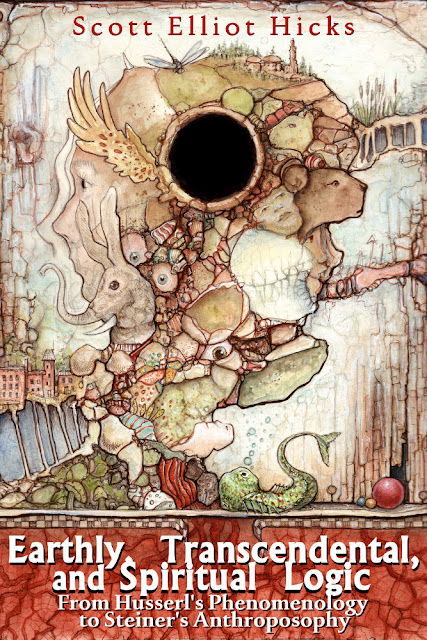
Excerpt from Earthly, Transcendental, & Spiritual Logic (Hicks, 2019) - Chapter 4 – Is the World Imagining Me? The Riddle of Imaginative Variation


Husserl is able to reach toward his refined sense of an idealism, which is grounded securely enough in self-evidence to provide a legitimate foundation for any possible science, by means of a specific methodology that reveals the archetypal or essential forms of the ideal objects pertinent to these sciences. This method takes place in the sphere of the phenomenological reduction, in the realm of imagination, and begins by turning the categorial intuition toward noematic-pictorial instances of relevant types of objects. For example, one could imagine a large number of different mammals, in clear and focused mental pictures, and in a playful but concentrated manner begin to alter the properties of these images in any way one chooses. We might transform the clearly lit-up image of a rabbit into an elephant by expanding the shape, size, coloring, and every other quality of the rabbit until the elephant is in intuitive view as a steadfast image. We then continue moving through a wide variety of other examples until a particular type of categorial object or conceptual framework comes into view in a higher sphere, which consists of the boundary conditions, essential determinations, and the fundamental productive notion at the bottom of every possible mammal. Because we are operating without the presuppositions of positivistic natural science, and are no longer concerned with cases of external fact as actually existent, we are permitted to stretch the fantasy as far as it takes us, while researching all of the possible species that could exist. We could imagine the Discomedusae that Haeckel illustrates from infinite angles, sizes, and profiles. We might therefore imagine some chimerical creature that does not exist, possessing the features of a sea-creature, mouse, lion, and mammoth combined. This fluidity of thought, which takes serious effort and many years to properly cultivate, then reveals the eidos. The particular images are set aside, and another self-evolving fabric of flexibility appears, which is connected to the region of thinking, and thoroughly penetrated with meaning. Husserl’s descriptions of this inner region of concept forms, which are fluid but perfectly clear, vivid, and completely near and saturated, always refer to their uniqueness. He is standing in them with the immediate understanding of their morphology, connections, significations, and boundaries, but they are like nothing seen in the sense world.  He says that the images used as a basis for imaginative or eidetic variation: 

"…present their essence to us; the individual intuition turns itself around, which itself is an eidetic possibility, into eidetic intuition, or into the attitude of thinking which on the ground of intuition grasps eidetic states of affairs in pure concepts and expresses them."

       In an analogous way to the manner in which the noematic nucleus provides a synthetic identity to the concrete instances of meaning-intentions concerning a single theme or object, the eidos is an essential ideal form that governs any possible manifestation of particular instances. One could say that rule that governs the elements of a set contains describable features that are not found in any of the elements of the set.  The wholeness of the mother is found virtually in every actual part. Furthermore, the mother can be seen with the objective Imagination faculty, or with scientific extrasensory perception. The creative power of the ‘empty category’ is the producer of its offspring, it is not the mere container in which they are gathered afterwards. In the same way, the prototypical plant-idea in Goethe shows directly, as it is intuited, that it can produce any plant from itself infinitely. For Husserl, the eidos or essence (Wesen) then can provide a universal basis for an ontological stratification that permits the determinate objects researched by the various scientific disciplines to be hierarchically arranged by category and region. For example, we discover that the intuition (whether sensible or categorial) of individual animals always contains an essential feature that clearly separates these intuitions from those of plants. This imaginative process should not be confused with the outcome of a hallucinatory fantasy. Husserl is convinced that free variation, used as a rigorous scientific methodology, can reveal the necessary foundations of any discipline. The eidetic essences reveal themselves as identical through different times and demonstrate themselves as impossible of being otherwise.

       At the ground of every material science must then be the self-giving of the possible boundary forms of objective research, what Husserl calls an ‘a priori science.’ The eide are the necessary and archetypal forms of possible objects that are referred to in specific judgments and propositions, but these eidetic objects “possess after all a pure essence fixable prior to all judicative content.” One can understand, then that in terms of intentional objects discovered in phenomenology, these eidetic essences are the highest stage and final goal of meaning fulfillment in Husserl’s transcendental project. Of course, a precise scientific language will be necessary to communicate the eidetic features, but language can no more fully express the eidos, than a whole book could completely describe the minute details of the flowers, grasses, birds, and colors in a single overgrown field.  Linguistic formulations and structures are necessarily grounded in the pre-linguistic noemata and eide that populate the sphere of meaning, and Husserl suggests that there is a natural connection between the linguistic expression and the essences themselves.  We find the deeper cause of this if we step into the realm of spiritual science, where we discover that there is an inner word that flows through all unfolding life at all moments. 

       However, it must be made absolutely plain that the eidetic essences are not abstract linguistic definitions that are discovered through a critical reflection (in the sense of the Kantian transcendental deduction) about what features would be essential and inessential to a particular concept. The noema is not a metaphor for Husserl. But the cave of Plato was also not a metaphor. True, Husserl does not yet see the sun outside the cave, but he begins to get close to the exit of the cave. Discovering the eidos is not a reverse deductive process taking place while one maintains the natural attitude of the positivistic sciences, and concentrates on the perceptible features of the external world, rather it is a direct experience of a lit-up object, an individual entity, in a noematic field that is arranged much like a visual field.  The ray of categorial intuition is unified with an individual object in its terrain that presents itself from the ‘front’ or horizon, and although it is not an individual image, it is the malleable source for possible images. Cognizing the essences is “the acquisition of a new region of being never before delineated in its own peculiarity – a region which, like any other genuine region, is a region of individual being.” It is experienced in a full saturation of categorial intuition, analogous in its degree of saturation to watching a movie with the external senses. To be even more precise, it is essential to differentiate at this point between three regions and manners of presentation in the mind’s eye, where a mental image can come to consciousness with the eyes closed.

       A) First, after closing the eyes, one can orient a primary ray of attention to a lower region of darkness in the field of the mind’s eye, while a weaker second ray of attention is simultaneously oriented toward a ‘higher’ region. This higher region is expressing the concepts that one is thinking by means of unclear images. These vague images, which often have a character determined by the impressions of memory, are experienced as unfolding outside the field of inner vision, in a sense, ‘behind’ or ‘beyond’ the primary ray of intention. It is almost as if one were buried in dirt and looking into the dark surroundings with one’s primary attention, while a barely functional periscope was turning around and surveying the air and light above the dirt. Another analogy might help. The experience of seeing someone’s hand in front of one’s face with external perception differs from the experience of feeling this same hand scratching one’s back, in that the full perceptual features are lacking in the second experience. But both experiences relate to a perception of the hand. In the same way, when the primary ray of attention is oriented toward the lower region of darkness (or toward word strings) it is as if the weaker secondary ray of attention is ‘seeing’ the images with the same degree of obscurity that one perceives a hand scratching one’s back. This is the sort of intuition of a representation or ‘mental image’ with which most people are familiar. It is for this reason that there has even been academic dispute about the image character of mental-pictures. Of course, most ‘thinking’ takes place while the eyes are open, and so the primary ray is usually oriented toward sense phenomena. This remains subjective. 

       B)  Through inner effort and practice in precise visualization, one may shift the primary ray of attention toward the higher region described above. With concentration, a new sort of presentation of mental images becomes apparent in this region, which brings them into full relief as clearly ‘seen’ pictures. During the process of ‘thinking’ or during the explicit process of eidetic variation, one can then hold the images in view; it is the case that they now possess a subtle quality that can be compared to watching the images on a movie screen reflected in a stream of slowly moving water. In this second case, the categorial intuition of the mental images is more like perceiving the hand out in front of one’s face, or shifting the primary attention to a fully functional periscope above the ground. Some people experience hypnogogic images which unfold precisely in this region and manner. This remains subjective. 

     C) To reach Husserl’s logical vision it is necessary to go one step further. In the phenomenological shift, which orients itself in order to register or grasp the eidos itself, a second ray of attention must move toward an examination of what is trying to assert itself through (or beyond) the images that are being transformed by the primary ray. The eidos stands forth as a proto-structural principle especially clearly when the primary ray of attention (in situation B) begins to retreat into the background by dropping the persistent tendency of the mind to insert images from remembered experience into this mold or prototype. This is a form of eidetic reduction, in which the presuppositions about what should appear as the essence are dropped, and the inherent biases present in the self are partially set aside. By setting some of the presuppositions out of play, the essence is allowed to self-present its own ideal formal and dynamic element without residue or remainder.8 This reduction then allows the phenomenological researcher to stand in “a world of absolutely pure possibility.”9  This virtual field has an immediate light character and an immediate meaning element within every little eddy or stream of it. The particulate flowing mental image shifts on its own, as it arises out of the imageless concept of immediately understood meaning ‘behind’ it. 

       In my experience, this world of pure possibility shows different qualities than the normal field in which noematic images are perceived (in the clearly evident ‘higher region’ in situation B). This step-C experience is made of an illuminated, malleable substance, and displays a coordinate of ‘grids’ stretching in many different dimensions, that can analogously be compared to the illustrations of curving space in Lobachevskian geometry. 
       
       This ‘game board’ is filled with repetitive streams of colors, and tiny elements that can take on a variety of forms, perhaps like some of Kandinsky’s paintings. This malleable substance seems to naturally take on shapes and impressions, as if it were the film receiving the impressions of light in an analog camera. It is obvious that such a vision inspired Harris’ illustration of the essential components of the second degree of Freemasonry that ends this chapter. It might be worthwhile to ponder this connection further. This is not yet the soul experience of the astral watery-light that Steiner calls the strata of mobile or flowing sensitivity (fließende Reizbarkeit), but it is instead made up of the dying grid of the reproduction of form in the etheric formative forces entering and surrounding the head.11  To move beyond this and cross into the soul and spiritual worlds, one must deal with the moral exposure of the impersonal fields which threaten to snuff out all sense of individuality, sense, and wakefulness. One has to behold the monsters that live in oneself, to truly perform the ‘spiritual reduction’ (could we call it level D? Yet the linear progression must end at level C). Of course, in Husserl’s sense, it would also be possible to perform an intuition of the eidos with the physical eyes remaining open, but the entire process becomes tainted by the overpowering influx of percepts from the external world.  Regardless, this is a problem that has to be solved individually by each serious spiritual scientific researcher. 

       Steiner also often suggested using a type of imaginative variation to grasp the universal or general concept as a mobile creative element:

"But we can also take the triangle as a starting-point, and allow each side to move in various directions and at different speeds…in this way we really do lay hold of the triangle in its general form; we fail to get there only if we are content with one triangle. The general thought, ‘triangle’ is there if we keep the thought in continual movement, if we make it versatile."

       He indicates that through this transformation of the static forms of species into the underlying generative movement, one is able to penetrate into the living spiritual process that creates the individual forms. The pulsing flux, which is the mother of all triangles, can be seen in the same place where one sees concepts.  Goethe, by using such a method, was able to discover the prototypes of plants and animals, which Husserl would call their eide. Husserl does seem to have been able to penetrate fully to level C, but he was focused more on the meaning elements, logical connections and formal ramifications, rather than the organic living power or image character of what was revealed. Steiner calls this noematic element or proto-structural flowing entity, “the living element which ramifies through the whole evolution of the animal kingdom, or the plant-kingdom, and creates the forms.”13  Yet, eventually there is some level at which the spirit of the triangle is just as living as the spirit of the flower. Thus, humans move in a living organic math as the plants grow in the life that underlies the Fibonacci stream. To cross into the spiritual world proper, one has to become the triangle (and yet remain oneself).  Then one can see the dying grid from the outside. 

       Husserl and Steiner will both agree that the concept of the triangle that you think of, is at bottom, the exactly identical one in the concept world that I think of. There is only one Washington Monument, likewise there is only one concept of leaf, zebra, circle, beauty, war, and so on. The psychologism that Steiner found in Logical Investigations became less prominent in the later Husserl. For Husserl, the eidos was the essential interior of the Washington monument. To think together is to plunge into the same ocean.  Humans are able to comprehend that they are accessing the same essence in two different experiences. When we intuit the eidos of ‘mammal,’ or form the proposition ‘The katydids are singing’ at two different times, a scrupulous awareness toward the original sense convinces us, with adequate evidence, of their identity. This numerical identity guarantees univocity of meaning, and thus the possibility of coherent communication altogether.  Of course, the essence is not the representation and it is not grasped in subjective thought.  As the post-structuralists aptly demonstrate, this essential unity does not mean that the meaning-life of the eidos cannot grow and change. It is virtually alive after all, and contains formlessness at the bottom of its spiritual roots. It is a pulsing formless self-differentiation that undergirds identity. Only I outside myself can know it and become it. But this différance is a positive phenomenon, since it allows you and I to create individual meaning elements and imaginative forms out of the identical-difference living in the underlying spiritual formlessness. Thinking is the feature that the formless Spirit creates in man, as Steiner points out.

       From Steiner we discover that there are other beings, forces, and active elements that can be spiritually seen that exist beyond what Goethe or Husserl were able to intuit. The etheric, astral, and spiritual worlds are full of elements and beings that become slowly apparent to the spiritual researcher. Furthermore, as we cross from the elements of color and form, and begin to see ourselves objectively from the outside with all of our moral failings and instinctual motivations, we must first begin to read the colors and forms of the spiritual world, but then begin to set them aside altogether. We are also split into an apocalyptic zodiacal multiplicity. Steiner says the following in his esoteric lessons, which must be received in a gentle and open way, in order to truly begin to understand and experience of what he speaks: 

"The spiritual world is first of all, completely colorless, lightless, soundless and so on. All the colours we see, for example, are not spiritual, but come from our own inner being, and they indicate those qualities which we do not yet have, which we still have to attain. If, for example, we see a red color, it means that we do not yet have love in us, that we have to develop it in ourselves. If we see purple, it means that we must acquire devotional piety. When we hear tones like earthly sounds, it is not something spiritual, but something that comes from ourselves. If someone has an appetite for a certain food, for example, or if someone starts to eat vegetarian food, but still has the inner, bodily inner desire for meat, even if he does not become aware of it, this appetite sounds out in tones, in discordant tones. All these tones and sounds are only the occult crowing of ravens! If a figure from earlier times appears to the disciple and he wants to interpret it in the same way, it is completely wrong. He must be able to wait with the interpretation. The pupil should not interpret in the present, but only later. If such an image comes before our soul, it is destroyed as soon as we come up with our thoughts. But if it is a real picture, it will appear again later and then rest in its true form, and we will know what it means. But we must be able to wait, wait and be silent. Just as we ourselves should not approach the experiences with our own thoughts, we should talk about them much less. We should consider and treat our whole spiritual life as something sacred. With all these experiences of sounds and colors and so on we must tell ourselves that they do not come from the spiritual, but from our own inner being, from our own self, which receives waves from the sea of desires and passions, as Noah's Ark was propelled by waves over the sea. And we must live in the conviction that all these experiences and appearances are not spiritual. By saying this very clearly and relentlessly to ourselves, we must, as it were, surrender our ego, give up the desire of our ego to experience content, to let it fly away, as the dove was let away from Noah's Ark and did not return. But then another occult experience of the disciple comes later. When we have realized that there is nothing, nothing spiritual about those experiences of sounds and colors, when we have realized with inner strength that the spiritual world is completely empty for us, then we realize that those experiences have a meaning after all, a meaning for ourselves. The colors come to warn and advise us then; they tell us what we do not yet have, what we still have to achieve. From the tones we recognize that they reflect bodily desires. And when the images that we have calmly let work tell us their meaning, then the soul is enriched by such experiences. This is like the second dove that was sent forth from the Ark and returned with the olive branch, the symbol of peace."
               

Wednesday, January 1, 2020

From a Blade of Grass to the Upright I-AM


Consider a single blade of living grass. Neither the elemental beings inside the grass nor the human staring at the grass from normal consciousness can really create or see the whole.  The whole is created in the middle, when the spiritual fire of love and knowledge can craft something artistically and scientifically in the middle zone, where we elaborate in language and conceptual fruitful form, a new human notion of grass. We live into the essence of the invisible light of the grass, the grass pulses back into the dying inscription into human consciousness as mental image. This requires us to carefully and self-consciously morph into the life of the plant through spiritual scientific research consciousness, keeping our thinking and our I awake and alert. 

Through this research, the following concepts arise: Grass is the steeple which takes the mineral earth and forms a new substance, striving to meet the heavenly in its neutral leaf formation.  It provides a channel where the liquid falling from the heavens can nourish the earth below, while the blade sprouts and slowly turns in the sweet air.  The blade of grass shows the impossible desire of flight, escaping gravity and with a million of its brothers and sisters, it rises, rises toward the nourishment from cosmic sun, moon, stars and sky. But it weaves its roots through the cool soil. And the human can find some of his or her own nature inside the grass, if he or she can create a concept as a formative open chalice for meeting soul, elemental, and spiritual life in nature.  This is where our work can pass over into anthroposophical fruitful research.  One can then, with the will of the I, look into where this new concept of grass intersects with other concepts – on which side, at which point?  Where does the formative impulse cause the repetitive growth of the blade of grass to connect with the concept of respiration?  How does it connect with the concept and activity of oxygen?  How does the spirit of oxygen, carbon, and grass work with world-respiration?  Here we can find in a single blade of grass the mysteries of the I-forces that live inside the human, as we stand erect, walking on the earth, a self-conscious link between earth and heaven. We are an upside-down walking plant, carrying its warmth around with it.